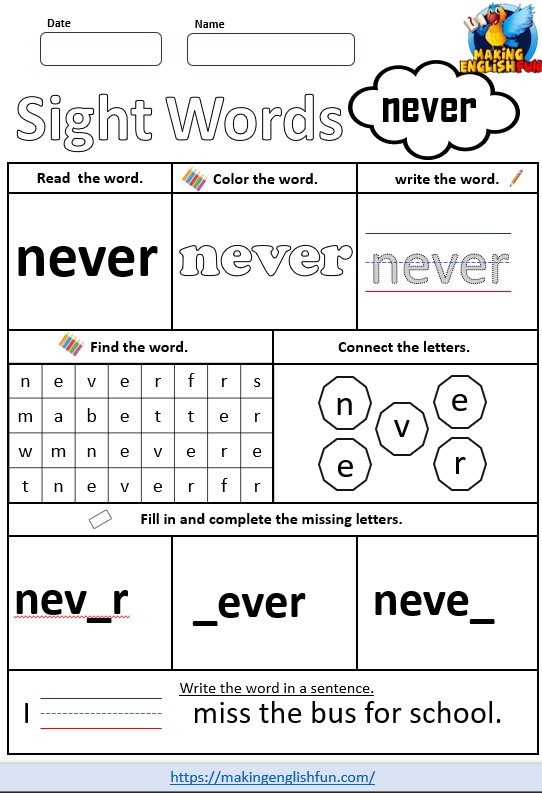
FREE Printable Grade 3 Dolch Sight Word Worksheet – “Never”
The sight word “never” is pivotal for Grade 3 students, highlighting concepts of permanence, decision-making, and time.
This guide, tailored for educators, ESL instructors, and parents, features a printable worksheet to aid children in mastering “never,” enhancing their ability to articulate definitive statements about actions or events that are not to occur at any time.
You can see the full grade 3 Dolch Sight Word worksheets sets on the links below.
Role of Sight Words
The term “never” is crucial for reading fluency and comprehension, enabling students to clearly understand and convey the absence of actions or events across various contexts.
For third graders, “never” enriches narrative depth and enhances logical reasoning, making it a valuable addition to their linguistic toolkit.
Free Sight Word ‘Never’ Worksheet
This worksheet dedicated to “never” includes targeted activities designed to reinforce familiarity with this term of negation and permanence.
Access to these educational resources ensures students can advance their understanding of complex time concepts and verbal expression.
Activities for ‘Never’
The “never” worksheet encompasses:
- Tracing practices to familiarize students with “never.”
- Identification tasks to bolster skills in spotting “never” within texts.
- Sentence crafting exercises to encourage the use of “never” in context, solidifying its application in expressing negation or permanence.
Overview of ‘Never’
A brief summary of “never” and its use:
| Aspect | Details |
|---|---|
| Sight Word | “never” |
| Meaning | At no time in the past or future; not ever. |
| Example | “She never forgot her first trip to the beach.” |
| Type of Word | Adverb |
Implementing the ‘Never’ Worksheet
Strategies for the “never” worksheet include:
- Recognition Activities: Engage students with tasks that highlight “never” in spoken and written scenarios.
- Writing and Tracing: Promote memorization and understanding through tracing “never” and constructing sentences.
- Contextual Discussion: Foster discussions that incorporate “never,” applying it to real-life scenarios and theoretical discussions to deepen comprehension.
You can download the printable sight word worksheet below and there are links to full sets of sight word worksheets above and below.
Complementary Learning Resources
To augment the “never” worksheet:
- Interactive Digital Tools: Utilize platforms that focus on adverbs and negation, especially those highlighting “never.”
- Flashcards: Employ flashcards featuring “never” for rapid recall and language reinforcement.
- Engaging Literature: Select stories and texts that effectively use “never,” encouraging discussion and application in narrative understanding.
We have more sight word resources here on the site and you can access these resources below as well.
- 40 FREE Printable Pre – K Dolch Sight Word Worksheets.
- 41 FREE printable grade 3 Dolch Sight Word Worksheets
- 25 Sight Word Games
- Is There An Order To Teach Sight Words?
- Sight Word Spelling Worksheets
- How to teach Sight Words And What Are They?
- Sight Words Worksheets: set 1-20
- Sight Words Worksheets: set 21-40
- 25 Free Kindergarten Sight Word Worksheets.
Engaging with ‘Never’
Creative methods to enhance engagement with “never”:
- Creative Writing: Encourage students to write stories or scenarios that incorporate “never,” fostering imaginative expression.
- Philosophical Debates: Introduce debates or discussions around topics that could involve “never,” such as making promises or discussing impossible events.
- Exploratory Tasks: Create tasks that challenge students to think about actions they would “never” do, linking to personal decision-making and ethics.
Conclusion
The “never” worksheet is a strategic addition to the “grade 3 Dolch word worksheets” collection, aiding the educational community in fostering a nuanced understanding of negation and permanence among students.
Mastery of “never” not only bolsters literacy skills but also encourages thoughtful reflection on the concept of time and decision-making, contributing significantly to students’ cognitive and emotional growth.
Making English Fun!

I have been a teacher of English for over 15 years, in that time i made hundreds and thousands of resources and learnt so much i think its worth sharing. Hopefully to help teachers and parents around the world.