FREE Printable Grade 3 Dolch Sight Word Worksheet – “Six”
The sight word “six” is fundamental for Grade 3 students, anchoring their understanding of numeracy and order.
This guide, crafted for educators, ESL instructors, and parents, offers a printable worksheet designed to help children grasp “six,” thereby enriching their mathematical vocabulary and enhancing their ability to recognize, count, and utilize the number in various contexts.
You can see the full grade 3 Dolch Sight Word worksheets sets on the links below.
Role of Sight Words
“Six” plays a critical role in developing reading fluency and mathematical comprehension, enabling students to smoothly integrate this numerical concept into their learning.
For third graders, becoming proficient with “six” is crucial for solving mathematical problems, understanding sequences, and navigating everyday situations that involve counting or grouping.
Free Sight Word ‘Six’ Worksheet
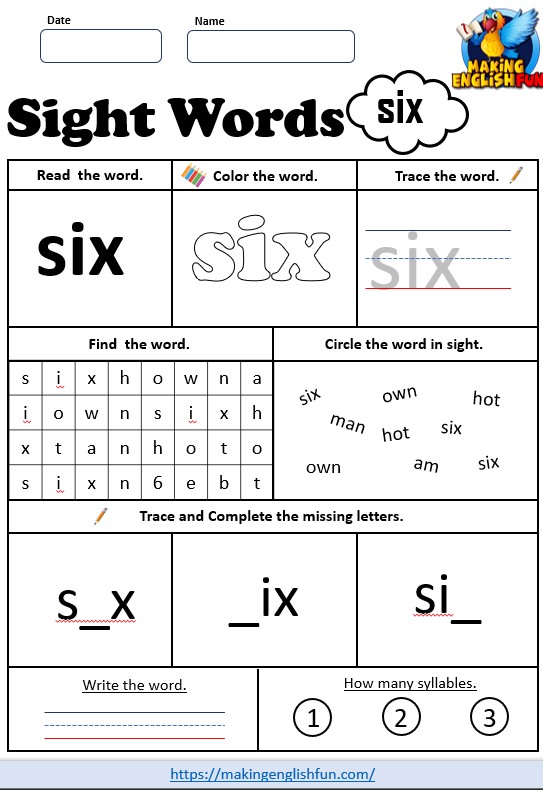
This worksheet dedicated to “six” includes targeted exercises aimed at reinforcing students’ familiarity with this number.
By providing such specialized educational materials, we ensure that learners can advance their numeracy skills and confidently engage with mathematical content.
‘Six’ Worksheet Activities
The worksheet features:
- Tracing tasks to encourage hands-on learning of “six.”
- Recognition challenges to enhance the ability to identify “six” within texts and mathematical problems.
- Sentence-making drills employing “six,” to solidify its use in numerical expressions and real-life scenarios.
Overview of ‘Six’
A brief summary of “six” and its significance:
| Aspect | Details |
|---|---|
| Sight Word | “six” |
| Meaning | The number following five and preceding seven; 6. |
| Example | “She has six apples in her bag.” |
| Type of Word | Noun |
Utilizing the ‘Six’ Worksheet
Effective strategies for the “six” worksheet include:
- Dynamic Recognition: Introduce varied exercises that highlight “six” in both numerical and written forms, cultivating familiarity.
- Writing Practice: Encourage tracing “six” and constructing sentences that contextualize its numerical value, aiding memorization and comprehension.
- Practical Application: Stimulate discussions and exercises that involve counting to “six,” comparing groups of items, or identifying sets of six to reinforce understanding.
You can download the printable sight word worksheet below and there are links to full sets of sight word worksheets above and below.
Complementary Educational Tools
- Interactive Learning Platforms: Digital tools that focus on the number “six” and other numbers, promoting engaging and contextual learning.
- Flashcards: Quick-reference cards featuring “six” for rapid recall and reinforcement of numerical concepts.
- Curated Reading Materials: Select books and stories that incorporate “six,” encouraging application
We have more sight word resources here on the site and you can access these resources below as well.
- 40 FREE Printable Pre – K Dolch Sight Word Worksheets.
- 41 FREE printable grade 3 Dolch Sight Word Worksheets
- 25 Sight Word Games
- Is There An Order To Teach Sight Words?
- Sight Word Spelling Worksheets
- How to teach Sight Words And What Are They?
- Sight Words Worksheets: set 1-20
- Sight Words Worksheets: set 21-40
- 25 Free Kindergarten Sight Word Worksheets.
Engaging with ‘Six’
Creative methods to help teach “six”:
- Mathematical Puzzles: Introduce puzzles or activities that require the use of “six,” such as finding six objects or dividing items into groups of six, linking numeracy with problem-solving skills.
- Creative Writing Prompts: Encourage students to write stories or scenarios involving the number “six,” fostering imaginative use and numerical understanding.
- Exploratory Projects: Organize projects or research tasks that explore the significance of “six” in different cultures, mathematics, or nature, promoting curiosity and investigative learning.
Conclusion
The “six” worksheet is a vital resource in the “grade 3 Dolch word worksheets” series, aiding the educational community in bolstering students’ numeracy and comprehension of numerical order.
Proficiency in understanding and utilizing “six” not only enhances mathematical literacy but also supports a broader engagement with educational content, contributing significantly to students’ academic development and confidence in numeracy skills.
Making English Fun!

I have been a teacher of English for over 15 years, in that time i made hundreds and thousands of resources and learnt so much i think its worth sharing. Hopefully to help teachers and parents around the world.