FREE Printable Grade 3 Dolch Sight Word Worksheet – “Pick”
The sight word “pick” is vital for Grade 3 students, emphasizing the act of choosing or selecting from a range of options.
This guide, designed for educators, ESL instructors, and parents, offers a printable worksheet to aid children in understanding and using “pick,” thereby enhancing their ability to articulate decisions and preferences.
You can see the full grade 3 Dolch Sight Word worksheets sets on the links below.
Importance of Sight Words
The word “pick” plays a crucial role in reading fluency and comprehension, enabling students to smoothly navigate texts that involve choices or the act of selection.
For third graders, mastering “pick” broadens their expressive capabilities, allowing them to discuss preferences, decisions, and actions with clarity.
Free Sight Word ‘Pick’ Worksheet
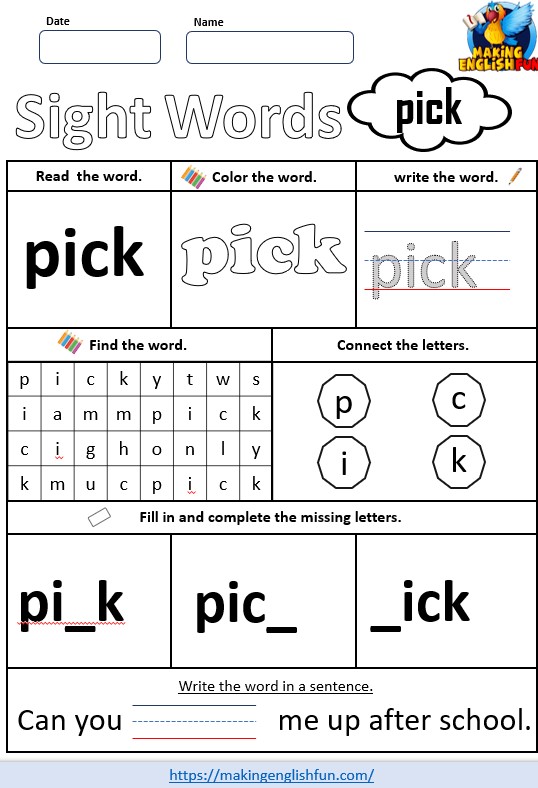
This worksheet dedicated to “pick” includes targeted exercises that reinforce students’ familiarity with this action-oriented word.
Providing accessible educational resources is key to supporting all students in advancing their language skills and decision-making vocabulary.
‘Pick’ Worksheet Activities
The worksheet features:
- Tracing tasks to engage students directly with “pick.”
- Recognition challenges to enhance skills in identifying “pick” within various texts.
- Sentence-making drills that use “pick,” promoting its contextual application and reinforcing understanding.
Overview of ‘Pick’
A brief summary of “pick” and its usage:
| Aspect | Details |
|---|---|
| Sight Word | “pick” |
| Meaning | To choose something from a group; to select. |
| Example | “Please pick your favorite color.” |
| Type of Word | Verb |
Utilizing the ‘Pick’ Worksheet
Effective strategies for the “pick” worksheet include:
- Dynamic Recognition: Introduce varied activities to spotlight “pick” in spoken and written forms, enhancing familiarity.
- Writing and Tracing: Support memorization and comprehension through tracing “pick” and crafting sentences that demonstrate its use.
- Practical Application: Encourage discussions and exercises that incorporate “pick,” relating it to everyday decisions and preferences.
You can download the printable sight word worksheet below and there are links to full sets of sight word worksheets above and below.
Supplementary Learning Resources
Expand the learning journey with:
- Interactive Tools: Engage with digital platforms that highlight “pick” in scenarios of choice and selection, emphasizing its practical use.
- Flashcards: Implement flashcards featuring “pick” for quick language practice and reinforcement.
- Reading Materials: Curate texts that utilize “pick,” encouraging students to identify and discuss its application in narrative and informational contexts.
We have more sight word resources here on the site and you can access these resources below as well.
- 40 FREE Printable Pre – K Dolch Sight Word Worksheets.
- 41 FREE printable grade 3 Dolch Sight Word Worksheets
- 25 Sight Word Games
- Is There An Order To Teach Sight Words?
- Sight Word Spelling Worksheets
- How to teach Sight Words And What Are They?
- Sight Words Worksheets: set 1-20
- Sight Words Worksheets: set 21-40
- 25 Free Kindergarten Sight Word Worksheets.
Creative teaching with ‘Pick’
Innovative methods to deepen connections with “pick”:
- Decision-Making Games: Introduce games that require players to “pick” options, linking the term with strategic thinking and preference expression.
- Creative Writing: Stimulate imagination with prompts that involve making choices, using “pick” to explore the consequences of those decisions.
- Exploration Tasks: Set up activities that allow students to “pick” topics of interest for research or presentation, fostering independence and curiosity.
Conclusion
The “pick” worksheet is an invaluable tool in the “grade 3 Dolch word worksheets” series, assisting the educational community in cultivating a nuanced understanding of choice and selection among students.
Proficiency in using “pick” not only enhances literacy but also supports students in expressing their decisions and preferences, contributing to their development as thoughtful and articulate individuals.
Making English Fun!

I have been a teacher of English for over 15 years, in that time i made hundreds and thousands of resources and learnt so much i think its worth sharing. Hopefully to help teachers and parents around the world.