FREE Pre – K Dolch Sight Word Worksheets – ‘said’
The sight word “said” is a past tense verb that’s pivotal for young learners, playing a crucial role in narrative storytelling and everyday conversation.
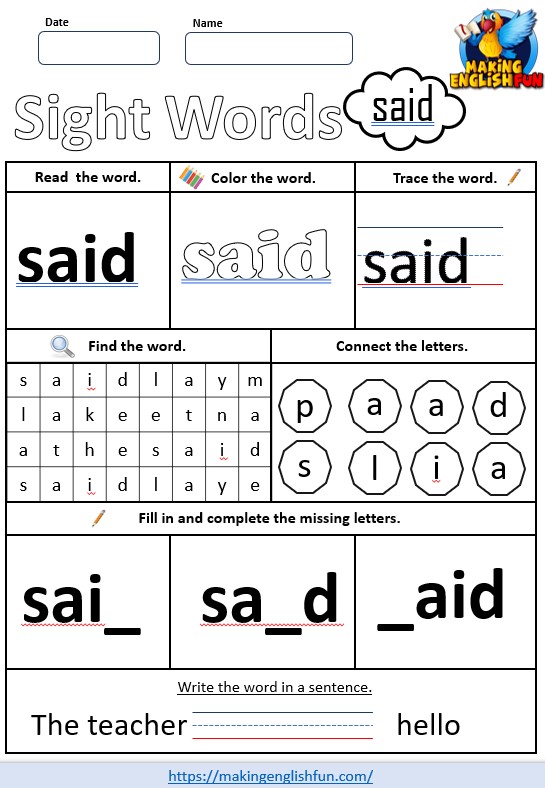
Designed for educators, ESL instructors, and parents, this guide features a printable worksheet aimed at helping children grasp the concept of “said,”
Thereby enhancing their understanding of dialogue and improving their reading comprehension and expressive abilities.
you can see the full sets on the links below.
The Importance of Sight Words
Sight words like “said” are fundamental to reading fluency.
These words, quickly recognized by sight, facilitate smoother reading and better comprehension, allowing young readers to focus on the content and context of conversations and narratives.
Mastery of “said” is particularly valuable as it helps children to accurately interpret and convey spoken words in texts.
Overview of ‘Said’
| Aspect | Details |
|---|---|
| Sight Word | “said” |
| Meaning | Used to report speech or indicate that words were spoken. |
| Example | “He said he would come.” |
| Type of Word | Verb (Past Tense) |
Free Sight Word ‘Said’ Worksheet
Our worksheet for “said” provides engaging exercises tailored to reinforce learners’ familiarity and application of this essential verb.
Access to high-quality, accessible educational resources is crucial for supporting equitable learning opportunities, enabling students from diverse educational backgrounds to advance their literacy skills.
Activities for ‘Said’
The worksheet dedicated to “said” includes:
- Tracing activities to familiarize students with “said.”
- Word recognition tasks for identifying “said” within texts, improving word recognition.
- Sentence construction exercises using “said,” reinforcing its use in contexts of reported speech.
You can download the printable sight word worksheet below and there are links to full sets of sight word worksheets above and below.
Implementing the ‘Said’ Worksheet
Effectively using the “said” worksheet involves:
- Recognition: Begin with activities that encourage students to recognize “said” in various contexts, enhancing familiarity.
- Tracing and Writing: Include tracing exercises for “said,” complemented by writing tasks to solidify spelling and recognition.
- Contextual Use: Apply “said” in sentences to deepen understanding of its role in reporting speech.
Supplementary Learning Resources
To expand on the worksheet activities, consider:
- Digital Learning Tools: Interactive games and apps that feature “said” for engaging and educational reinforcement.
- Flashcards: Use flashcards with “said” for quick and effective review.
- Engaging Reading Materials: Select books and stories rich in dialogue that frequently use “said,” discussing its context to reinforce understanding.
We have more sight word resources here on the site and you can access these resources below as well.
- 25 Sight Word Games
- Is There An Order To Teach Sight Words?
- Sight Word Spelling Worksheets
- How to teach Sight Words And What Are They?
- Sight Words Worksheets: set 1-20
- Sight Words Worksheets: set 21-40
- 25 Free Kindergarten Sight Word Worksheets.
Creative Approaches to Learning ‘Said’
Enhance engagement with “said” through creative methods:
- Art and Drama Projects: Encourage drawing scenes from stories or acting out dialogues that use “said,” linking literacy with creativity and performance.
- Writing Prompts: Challenge learners to write sentences or short stories incorporating “said,” promoting creative expression and application.
- Discussion Activities: Stimulate discussions about different ways to express “said” (e.g., whispered, yelled, remarked), enhancing vocabulary and comprehension.
Join Our Literacy Community
Our community offers a wealth of resources, including teaching strategies, worksheets, and activities focused on essential sight words like “said.”
It’s a supportive space for educators, parents, and literacy advocates to share experiences and resources, all aimed at fostering early reading and writing skills.
Advancing Literacy Development
Stay updated with ongoing resources and updates designed to enrich literacy education, including comprehensive materials for teaching key sight words.
Our collective goal is to equip young learners with foundational reading and writing skills, encouraging a lifelong journey of literacy and learning.
Together, we’re empowering children to navigate the nuances of dialogue with “said,” enriching their literacy journey one word at a time, and building their confidence in reading and storytelling.
Making English Fun!

I have been a teacher of English for over 15 years, in that time i made hundreds and thousands of resources and learnt so much i think its worth sharing. Hopefully to help teachers and parents around the world.