What is the Difference Between High Frequency and Dolch Words?
If you’ve ever used “high-frequency words” and “Dolch words” interchangeably, then you may be sad to hear that you’ve been using them incorrectly all this time. While there is a certain amount of crossover, they are two distinct and separate ideas. We’ll do our best to explain that difference in today’s post.
Dolch words are a list of 220, later expanded to become 315, words that Edward Dolch collated as part of the whole word theory of language in 1936. High Frequency word lists are less rigid and are lists of the most used words in English. Both aim to give emerging students of English a grounding of vocabulary.
If you have misused these terms, don’t worry. The English language is full of common mistakes made even by the most experienced teachers, such as those who say “proNOUNciation” instead of “proNUNciation,” claiming it to be “American English.” No, sir or madam, it’s just wrong.
What are “High-Frequency” and “Dolch” Words?
High-Frequency Words
There are seemingly countless numbers of lists created that claim the title “high-frequency” words. These are lists of words that are made according to the frequency that certain words are used in print.
In other words, they are designed to help students master those words that they are most likely to see first and most often. These lists differ in length and content and can be tailored and created to suit all kinds of needs: age, English level, theme, etc.
Dolch Words
These are a specific set of 220 words first put together by educator Edward William Dolch back in 1936. Dolch was a major proponent of the “whole-word” theory, the foundational theory for the teaching of what we now commonly call “sight words.”
The terms “Dolch words” and “sight words” are also often used interchangeably, but the main thing to remember is that any word only becomes a sight word when a learner can recognize it immediately at first sight. That is to say, they can recognize the words without having to break them down into smaller parts, instead seeing it as a whole word that they know and understand.
So, while Dolch words do eventually become sight words, all things going to plan, they are not strictly speaking in themselves sight words.
Dolch Words: List Construction
The Dolch list is actually a series of smaller lists divided as follows:
- Pre-primer (40 words)
- Primer (52 words)
- 1st Grade (41 words)
- 2nd Grade (46 words)
- 3rd Grade (41 words)
- Nouns (95 words)
The non-noun lists make up the main 220-word Dolch list from 1936, but it has since been updated with nouns to make the total 315 words. We’ve put some examples from each list in the table below:
Table 1: Examples of the 315 Dolch Words
| Table Name | Example Words |
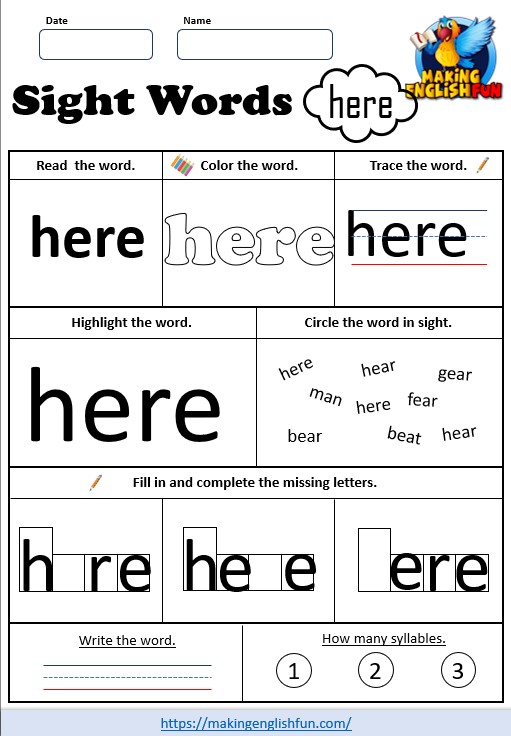
| Pre-primer | a, away, big, blue, can, down, for, funny, here… |
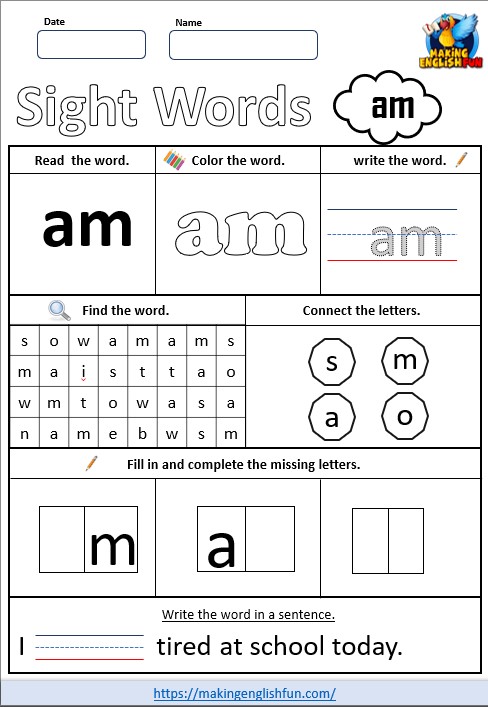
| Primer | am, ate, black, came, four, have, must, please… |
| 1st Grade | after, again, could, every, going, just, know, live… |
| 2nd Grade | always, around, been, before, five, found, gave, made… |
| 3rd Grade | about, better, clean, done, drink, eight, kind, laugh, much… |
| Nouns | apple, baby, back, birthday, brother, children, Christmas… |
There is actually a PDF version of the dolch word list here from Dochword.net

What Are the Most Important Differences Between High-Frequency and Dolch Words?
From the above definitions, we might then draw the conclusion that all Dolch words are high-frequency words, but not all high-frequency words are Dolch words. The latter distinction is helped by some key differences:
Target Learners
High-frequency words are not specific to any one age group, nor necessarily to any reading level. They can be organized into lists that cater to virtually any and every learner demographic. On the other hand, Dolch words are those specific ones aimed at early years learners to help them open the door and get over the threshold into the world of fluent and competent reading.
Recognition
High-frequency words can be employed by proponents of the whole-word method, or by those who teach using phonics. The lists themselves are just words that frequently come up in print, and are therefore key to learners mastering reading in English. They don’t necessarily have to be recognized as whole words, but can also be broken down and taught in any way that a teacher or learning institution prefers.
Dolch words, on the other hand, are specifically compiled to become sight words and that is their stated intention. Of course, any educator could simply take the Dolch list and use it in their own way, but our point here is that the Dolch words list was conceived as a one-word method list from the beginning, unlike many other lists of high-frequency words.
Edward Fry produced his own list (see further below) in 1979 that augmented the Dolch list, but the intention remained the same since Fry was also a proponent of the whole-word approach.
Ease of Becoming Sight Words
Since the Dolch words were put together specifically for elementary school learners, it could be argued that these relatively simple high-frequency words are easier to convert into sight words. That same argument is harder to make broadly for all high-frequency word lists. There is certainly some crossover, with similar early-years’ high-frequency words more easily becoming sight words, but 100-percent of Dolch words fit that definition.
Dolch Vs. Fry
Of course, there are two main sources of high-frequency word lists that school teachers try to make into sight words, namely the Dolch list from 1936, and the more up-to-date Fry list from 1979.
The Dolch list contains 220 of what its creator called “service words” that he believed were the most necessary for young learners to gain strength and fluency in reading. Fry’s list is more comprehensive, containing 1,000 words in total.
These lists are still commonly used by elementary schools to help students gain proficiency in reading through a method known as the whole-word method of skill acquisition. As it happens, there is a lot of notable criticism leveled against the one-word method and sight words, in particular from champions and other proponents of phonics. We’ll cover more about this in the sections below.
Benefits of Using High-Frequency Words and Dolch Words
For these benefits, we’ll focus on using these word lists in a similar way to create sight words, as opposed to using them with a phonics-based approach where kids learn to “decode” and sound out the words they’re looking at.
Learners Become Faster, More Competent Readers
Instant recognition of common words allows learners to become faster and better readers in a shorter time. The method of sounding words out only becomes cumbersome (more on that further below), whereas instant recognition of those common words allows for greater tracts of text to make sense to readers sooner rather than later.
Helps Overcome the Inconsistencies of English
Let’s face facts, the English language is — to borrow a phrase from the popular show Family Guy — an absolute casserole of nonsense, isn’t it? It’s full of contradictions and other nonsense that make it plain infuriating for people to learn, be they native or second-language learners. Take the pronunciation of “ough” as an example here, and try explaining that to students in a couple of simple steps — you can’t.
This is where sight words proves yet another aspect of its worth, that is in helping students recognize words that if sounded out would only create confusion. Ask students to “sound out” the following words:
- cough, bough, dough, trough, borough, through
How many of them rhyme? Can you tell in an instant, even as an experienced reader? You probably recognize these words more from context and memory than from breaking them down, right?
Sight words help young learners cut through the baffling mists of the English language and gain competency and comprehension faster when learning to read. Why let kids get so caught up in the weeds like they can do in phonics?

Instant Recognition Builds Confidence in Learners
There’s a certain power in being able to instantly recognize something without feeling the need to investigate, sound anything out, or deconstruct it. Proponents of phonics might argue that being able to decode words by looking at their individual parts and sounding them out bit by bit helps students to face any challenge that comes their way.
This may be true, but it keeps the process slow, and creates a shallow rising curve of confidence building. When a learner can look at a book or other text and feel they know enough to hit the ground running through their existing knowledge of sight words, that is empowering, and encourages them to challenge themselves.
It also means they’ll have enough time and energy to focus on harder words they encounter, which brings us to our final benefit.
Allows Learners to Focus Attention on More Difficult Words
The business of breaking words down and sounding them out sounds good when you’re looking at words individually, but it can translate into quite a different experience when one is trying to read a book or a comprehension passage later on.
Young learners can become so lost in sounding words out, that they lose their train of thought on the story, instead focusing on the mission to discover what all the various constituent elements of each word are.
When children are taught sight words, the majority of words are instantly recognizable, allowing them to focus their attention on more challenging new words that warrant additional attention, rather than simpler (but still interesting) words that one could argue needn’t take up so much time. This leaves enough energy and focus to both pick up new and challenging words, while still appreciating the wider meaning and content of the text.
Criticism of the Use of High-Frequency Words, Dolch Words, and the Whole-Word Method
Believe it or not, the criticism pointed at both whole-word and whole-language approaches to reading is quite strong, and loud. It’s not only those who prefer the approach of phonics who are against the method either, although they are arguably the most well-defined and visible intellectual opposition to this outlook.
At the heart of the anti-Dolch spiel is the fact that it fails to teach young learners what are known as decoding techniques. That is to say, when children memorize words using the whole-word approach, they miss out on gaining a deeper and more profound understanding of the language that comes from decoding it, breaking it down into its constituent parts.
To use a more advanced example as an analogy, take the word “telephone,” for instance. Most of us reading this piece today will have learned this word as is and now remember it and know it at first glance without really having to read through it and get a grip on it.
However, some of us later discovered that “tele” and “phone” as parts of this word are both derived from Ancient Greek words. “Tele” means “from afar” and “phone” means “voice” or “sound.” When you put that together and appreciate the constituent parts, you feel you connect with that word on a whole new level.
Similarly, it is argued that young learners gain that same kind of appreciation and understanding when they use an approach such as phonics to learn reading. They are able to decode the language into its constituent parts and really know what makes those words tick.
It’s not only linguists who have come out against Dolch words and sight words, but even cognitive neuroscientists. Stanislas Dehaene once wrote
“cognitive psychology directly refutes any notion of teaching via a ‘global’ or ‘whole language” method” and “We do not recognize a printed word through a holistic grasping of its contours, because our brain breaks it down into letters and graphemes.”
Dehaene, “Reading in the Brain”
FREE High Frequency and Dolch Resources
As promised we have listed some resources both printable and guides on teaching for sight, high frequency and, as explained above, therefore dolch words below. These are free to download we just ask for credit if you share them.
- How to teach sight words
- is there an order to teach sight words
- Best Online Sight Word Games
- 1-20 Sight Word Worksheets
- 21 -40 Sight word worksheets
- 25 Sight Word Worksheets
- Sight word Spelling worksheets
Conclusion: Do the Differences in High-Frequency Words and Dolch Words Matter?
At the end of the day, how important is it that we help correct you on using these two terms interchangeably as you did before? As you can now see, there is still a lot of crossover between the two, and their real differences only emerge in how we strictly interpret the usage and implementation of these words, in essence.
Having said that, we feel it’s always good to know all the finer points of one’s subject, and as educators it’s critical that we know precise definitions and where any differences in similar concepts lie.
Without this knowledge, we fail to pass on that level of nuance and intelligence to our students. This also serves as a strong lesson in critical thinking for both our personal and professional lives: that no matter how much crossover there is between two things, there are still interesting and meaningful differences that are worthy of our attention.
References
- https://www.researchgate.net/publication/271158569_Reading_in_the_brain_by_Stanislas_Dehaene
- https://www.readandspell.com/blog/what-are-dolch-words#
- https://www.dolchword.net/
Making English Fun!

I have been a teacher of English for over 15 years, in that time i made hundreds and thousands of resources and learnt so much i think its worth sharing. Hopefully to help teachers and parents around the world.