15 Fun Speaking Activities for ELL Students to Build Confidence and Fluency
Speaking is often the most challenging skill for English Language Learners (ELLs) to master. Many ELLs hesitate to speak up due to a fear of making mistakes, embarrassment, or difficulty expressing themselves in front of their peers.
One proven way to overcome these barriers is to use engaging speaking games and activities that build confidence while making language learning fun.
In this article, we’ll explore 15 fun speaking activities designed specifically for ELL classrooms. These games will help your students practice conversation, build fluency, and become more comfortable using English in a variety of real-world scenarios.

Whether you’re working with beginners or more advanced students, these activities will fit seamlessly into your lesson plans and get your students talking.
1. ELL Speaking Game: 30 Second Speech
The goal of this activity is for students to speak on a given topic for 30 seconds without hesitation or repetition.
This exercise helps build fluency and quick thinking.
Instructions:
- Choose a topic that is appropriate for your learners’ level, such as “favorite food” or “a place I’d like to visit.”
- Give each student 1 minute to prepare.
- Students then speak for 30 seconds without using fillers like “um” or repeating themselves.
- If they hesitate or run out of things to say, the next student in line continues with the same topic.
Tip: Start with easy topics and gradually increase difficulty as students gain confidence.
How to Use the 30 Second Speech Activity for ELL Students:
- Choose a topic: Pick a simple topic like “My favorite food” or “A place I want to visit.”
- Set the timer: Give students 1 minute to prepare and 30 seconds to speak.
- Rules: No pauses, no “um” or “uh,” and no repeating the same words.
- Scoring: If they complete without hesitation, they get a point!
2. Quick Fluency Game: Word Association for ELL Students
This fast-paced game is great for practicing vocabulary and quick thinking. It’s ideal for all ages and can be adapted for different themes.

Instructions:
- Choose a category (e.g., animals, colors, food).
- Students stand in a circle and take turns saying a word that belongs to that category within 3 seconds.
- If a student hesitates, repeats a word, or says something unrelated, they sit out.
Tip: To keep everyone engaged, introduce more challenging categories as students improve.
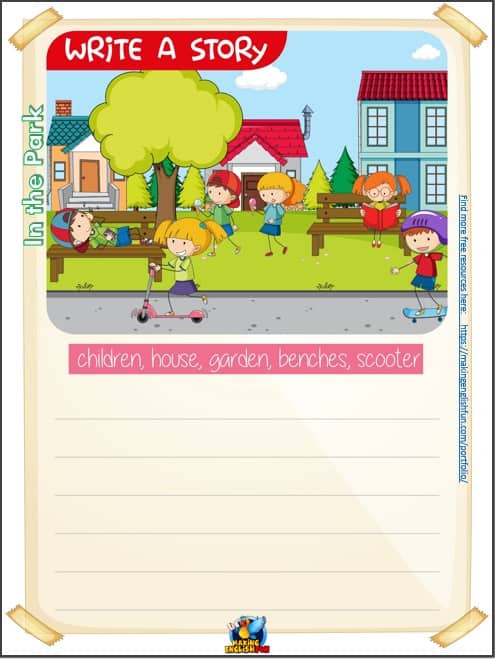
3. Picture Description
This activity encourages ELL students to use descriptive language and practice using adjectives.
We have two sets here on the site
Instructions:
- Show students a picture related to the topic you’re covering (e.g., a park scene, a classroom).
- Ask each student to describe one element in the picture (e.g., “The boy is riding a bicycle”).
- As an extension, have students work in pairs and take turns describing pictures to each other.
Tip: Use culturally relevant images to make the activity more relatable and engaging.

4. Interactive ELL Activity: Role-Play Scenarios
Role-playing is an excellent way to help students practice real-life conversations in a safe environment.
Instructions:
- Create simple role-play scenarios (e.g., ordering food in a restaurant, asking for directions).
- Assign students roles and provide them with key phrases to use.
- Students act out the scenario in pairs, focusing on correct pronunciation and intonation.
Tip: Let more confident students perform their role-plays in front of the class for additional speaking practice.
5. Two Truths and a Lie
This classic game is perfect for practicing speaking skills while also getting to know your students better.
Instructions:
- Each student writes down two true statements and one false statement about themselves.
- Students take turns reading their statements, and their classmates must guess which statement is the lie.
- Encourage students to ask follow-up questions to determine the truth.
Tip: Use this activity as an icebreaker at the start of a new term.
6. Guess Who?
Adapted from the popular board game, this activity helps students practice asking and answering questions.
Instructions:
- Prepare cards with pictures or descriptions of famous people or characters.
- Each student draws a card and must guess who they are by asking yes/no questions (e.g., “Am I an athlete?”).
- The rest of the class answers the questions until the student guesses correctly.

Tip: Use images of local celebrities or culturally relevant figures to increase engagement.
7. Story Building
This creative activity is great for encouraging group collaboration and speaking fluency.
Instructions:
- Begin by giving students a story starter (e.g., “Once upon a time, there was a boy who found a magical key…”).
- Each student adds one sentence to continue the story.
- Keep going around the group until the story reaches a conclusion.
Tip: This can also be done in written form for a combined speaking and writing activity.
8. Game-Based Learning: The Yes/No Game for ELL Students
This game is a fun way to get students to speak without relying on short, simple answers.
Instructions:
- Students stand in a line.
- One student is chosen to answer questions from the class.
- The catch? They can’t say “yes” or “no” in their answers!
- If they slip up, they’re out, and the next student takes a turn.
Tip: Choose questions carefully for lower-level students to ensure they understand what’s being asked.
9. Picture Sequencing
This activity helps ELL students practice storytelling and logical sequencing.
Instructions:
- Choose a set of pictures that tell a simple story (e.g., making a sandwich).
- Hand out the pictures and have students work in pairs to put them in order.
- Each pair must then present their story to the class.
Tip: Use topics that are relevant to your students’ lives to make the stories more engaging.

10. Vocabulary Practice: Taboo for ELLs
This game encourages students to use alternative vocabulary to explain a given word.
Instructions:
- Create a deck of cards with a target word (e.g., “doctor”) and three “taboo” words they cannot say (e.g., “hospital,” “medicine,” “nurse”).
- One student has 1 minute to describe the word without using the taboo words.
- The other students must guess the word.
Tip: Include topic-specific vocabulary to reinforce lessons.
11. Pictionary
Pictionary is a fantastic game for practicing speaking and listening skills while adding some creativity.
Instructions:
- Divide the class into two teams.
- One student from each team draws a word from a hat and tries to draw it on the board.
- Their team has to guess what they are drawing within 1 minute.
- The team that guesses correctly first wins the round.
Tip: Use categories relevant to your lesson (e.g., emotions, school objects).
12. Find Someone Who…
A great way to get students moving around and speaking to everyone in class.
Instructions:
- Create a list of statements (e.g., “Find someone who has been to another country”).
- Students walk around asking classmates questions until they find someone who fits the description.
- When they find a match, they must ask follow-up questions and take notes.
Tip: This activity works well as a warmer or filler at the beginning of class.
13. Debate Club
Debates are ideal for high school or advanced ELL students to practice arguing their opinions and using persuasive language.
Instructions:
- Choose a relevant topic (e.g., “Should uniforms be mandatory in schools?”).
- Divide the class into two teams and assign one team to argue for the topic and the other to argue against.
- Give each team time to prepare their arguments, then hold the debate.
Tip: Focus on respectful language and active listening skills. We have a list of possible topics here
14. Simon Says
This classic game is great for beginner learners to practice listening and speaking commands.
Instructions:
- The teacher plays “Simon” and gives commands starting with “Simon says…” (e.g., “Simon says touch your head”).
- If Simon doesn’t say the phrase “Simon says” before the command, students must not follow it.
- If a student makes a mistake, they are out.
Tip: Use this as a warm-up or to review vocabulary.
15. The Memory Game
This game is ideal for vocabulary retention and speaking practice.
Instructions:
- Put 10-15 objects on a table and let students look at them for 1 minute.
- Cover the objects and ask each student to name as many as they remember.
- For a more advanced version, have students describe each object instead of just naming them.
Tip: Use objects relevant to your current topic of study.
According to TESOL’s Best Practices, using interactive activities can significantly reduce speaking anxiety and boost ELL students’ willingness to participate in class discussions.
Conclusion:
Incorporating speaking games into your ELL classroom is one of the most effective ways to get students engaged and actively using English. By creating a low-pressure environment, these activities help students overcome their fear of speaking and allow them to practice real-world conversation skills.
Whether you’re teaching beginners or advanced students, you can adapt these games to match your students’ needs. As you try these activities, remember to focus on building a supportive and encouraging atmosphere where mistakes are part of the learning process.
For more resources, check out our collection of ELL speaking worksheets and free printable conversation cards to enhance your lessons even further!
Frequently Asked Questions:
Q: What are some good ELL speaking activities for beginners?
A: For beginners, focus on simple games like Simon Says, Yes/No Game, and basic role-play scenarios. These activities provide structure and support while still allowing students to practice speaking.
Q: How do you motivate ELL students to speak more in class?
A: Motivation can be built by creating a low-stress environment, using games that involve teamwork, and offering positive feedback. Gradually increasing the complexity of tasks can also help students build confidence.
References
https://jimmyesl.com/easy-esl-speaking-activities-practice/
Making English Fun!

I have been a teacher of English for over 15 years, in that time i made hundreds and thousands of resources and learnt so much i think its worth sharing. Hopefully to help teachers and parents around the world.