FREE Pre – K Dolch Sight Word Worksheets – ‘up’
The sight word “up” is not just a direction; it’s a doorway to expanding young learners’ understanding of movement, position, and perspective.
This article is crafted for educators, ESL instructors, and parents, featuring a detailed guide and a printable worksheet designed to help children master the sight word “up,”
thereby enhancing their descriptive abilities and enriching their engagement with both spoken and written language.
you can see the full sets on the links below.
Understanding the Role of Sight Words
Sight words like “up” are essential in achieving reading fluency. Recognized by sight rather than sounded out, these words enable smoother reading and improved comprehension.
The word “up” is particularly versatile, used to describe direction, increase, or even a state of being, making it a valuable addition to a child’s vocabulary from an early age.
Overview of ‘Up’
| Aspect | Details |
|---|---|
| Sight Word | “up” |
| Meaning | Towards a higher position; at a higher level or layer. |
| Example | “She climbed up the ladder.” / “The sun is up.” |
| Type of Word | Preposition, Adverb, Adjective |
Free Sight Word ‘Up’ Worksheet
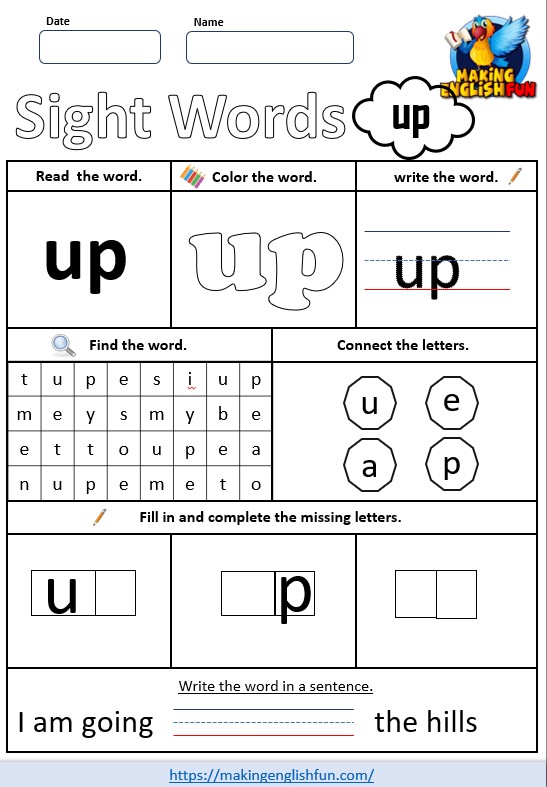
Our “up” worksheet offers targeted exercises aimed at reinforcing recognition and understanding of this dynamic word. High-quality, accessible educational materials are crucial for supporting equitable learning opportunities, helping students from diverse backgrounds to grow their literacy skills confidently.
You can download the printable sight word worksheet below and there are links to full sets of sight word worksheets above and below.
Activities for ‘Up’
The worksheet dedicated to “up” includes:
- Tracing tasks to familiarize students with the word “up.”
- Word recognition exercises that help identify “up” within various texts, enhancing word recognition skills.
- Sentence construction activities that encourage the use of “up” in different contexts, reinforcing its versatile application.
Implementing the ‘Up’ Worksheet
Effectively using the “up” worksheet involves several strategies:
- Recognition: Begin with activities that enhance students’ ability to recognize “up” in spoken and written form, building familiarity.
- Tracing and Writing: Tracing “up” helps with memorization and recognition, while writing exercises solidify understanding and spelling.
- Contextual Use: Encouraging the use of “up” in sentences or stories to deepen comprehension of its various meanings and uses.
Supplementary Learning Resources
To further enrich the learning experience, consider incorporating:
- Digital Learning Tools: Engaging games and apps that emphasize the word “up” offer fun, interactive reinforcement.
- Flashcards: Quick, effective review sessions with flashcards featuring “up” and other sight words.
- Engaging Reading Materials: Books and stories with frequent use of “up,” facilitating discussions about its meaning and encouraging sentence construction.
We have more sight word resources here on the site and you can access these resources below as well.
- 25 Sight Word Games
- Is There An Order To Teach Sight Words?
- Sight Word Spelling Worksheets
- How to teach Sight Words And What Are They?
- Sight Words Worksheets: set 1-20
- Sight Words Worksheets: set 21-40
- 25 Free Kindergarten Sight Word Worksheets.
Creative Approaches to Learning ‘Up’
Boost engagement and understanding of “up” through creative methods:
- Art Projects: Encourage artwork depicting scenes that involve the concept of “up,” linking creativity with literacy.
- Physical Activities: Organize simple jumping or reaching activities, using “up” as a directive to embody the word’s action, enhancing kinesthetic learning.
- Writing Prompts: Challenge learners to create sentences or short narratives incorporating “up,” fostering creative expression and application.
Conclusion
With the free “up” worksheet and a variety of engaging activities, educators, parents, and caregivers are equipped to guide young learners in mastering this foundational sight word.
As children explore and understand the concept of “up,” they not only enhance their vocabulary but also develop a deeper appreciation for the nuances of language, setting a solid foundation for lifelong literacy.
Making English Fun!

I have been a teacher of English for over 15 years, in that time i made hundreds and thousands of resources and learnt so much i think its worth sharing. Hopefully to help teachers and parents around the world.