525+ Nonsense Words Lists
As we discuss all over our site, phonics plays a pivotal role in early reading development, laying the foundation for successful literacy skills.
Nonsense words are used as an important tool in this journey. Unlike familiar words, these nonsensical combinations challenge learners to apply their phonetic knowledge, ensuring their reading skills are not merely a product of memorization.
Bellow we have lists of Nonsense words split into 7 sections to help you use them when needed in your classrooms and homes.

These sections are
- Nonsense CVC Words
- Nonsense Blend Words
- Nonsense Digraph Words
- Nonsense Vowel Teams
- Nonsense Silent E Words
- Nonsense R Controlled Words
- Nonsense Multiple Syllable Words.
You can click on the list above and it will jump the section you need (to save you time)
What Are Nonsense Words
Nonsense words are artificially created words that follow phonetic rules but do not have a predefined meaning.
These words are constructed to include specific phonetic elements, such as vowel teams, consonant blends, or digraphs, allowing educators to target specific areas of phonics instruction.
By using nonsense words, teachers can accurately assess a student’s ability to decode and understand phonetic patterns without relying on memorization or context clues.
Why Use Nonsense Words in Phonics Teaching
Nonsense words are invaluable in phonics education for several reasons.
- Firstly, they ensure that students are not simply recognizing words by sight but are actively using phonetic rules to decode words. This reinforces their understanding of phonics principles.
- Secondly, nonsense words provide a level playing field for all learners, as these words are new to everyone, eliminating any advantages of prior vocabulary exposure.
- Finally, they offer a fun and creative way to engage students, making phonics learning more interactive and enjoyable.
75 CVC Nonsense Words List

This table has 75 nonsensical CVC words for each vowel (a, e, i, o, u) Nonsense words are invaluable tool for educators to assess students’ phonics skills without relying on memorized vocabulary.
Consonant-Vowel-Consonant (CVC) words form the bedrock of early phonics learning. These simple structures are ideal for beginners, as they follow a predictable pattern of sound and letter arrangement.
The CVC nonsense word list helps as an excellent starting point for young readers, helping them grasp the basics of blending sounds to form words.
Printable Table of CVC nonsense Words
| CVC_a | CVC_e | CVC_i | CVC_o | CVC_u |
|---|---|---|---|---|
| vas | nen | nis | bol | vup |
| yax | ret | dif | woj | ruv |
| fam | ked | diz | yos | rul |
| das | fex | tig | tov | zud |
| vad | vef | til | bom | gud |
| cac | wef | wid | jox | tud |
| bas | heg | nic | sok | kuc |
| gam | tef | gid | foc | yug |
| sak | bem | zij | gos | tuj |
| dal | det | sif | boj | zub |
| hak | peb | bil | gox | muv |
| pag | deg | dij | sof | nud |
| rav | pef | sik | yot | yut |
| yaz | jev | hiz | dob | nus |
| kaf | rek | wis | tok | mux |
75 Silent E (CVe) Nonsense Word List

Each word in this table includes nonsense words the silent ‘e’ rule, making it a useful resource for teachers aiming to improve students’ decoding skills in a controlled, non-repetitive manner.
The silent ‘e’ (VCe) pattern is a key concept in English phonics, often serving as a turning point for young readers in understanding how vowels can change sounds within words.
| VCe_a | VCe_e | VCe_i | VCe_o | VCe_u |
|---|---|---|---|---|
| kake | lete | tine | yose | fuxe |
| gaxe | teve | zite | nobe | puxe |
| mete | neke | nipe | zove | wuge |
| yade | leve | hibe | voze | sute |
| vame | peve | vixe | tode | wute |
| hawe | lebe | zike | nofe | buke |
| rame | feme | pibe | hode | gupe |
| bave | vece | vite | goke | gute |
| fafe | fege | fige | joge | suge |
| sape | jepe | jile | kode | fude |
| pape | peze | zile | wope | mune |
| zave | vefe | bive | lole | zuze |
| bame | geve | gike | cofe | sude |
| hace | deze | sime | pode | luxe |
| raje | jepe | hise | toxe | mude |
90 Blends Nonsense Word List

Our nonsense word table with consonant blends (br, bl, gl, gr, cr, cl) is a resource for teaching how these blends function within words.
Consonant blends involve two or more consonants combined together, each retaining its sound.
| br | bl | gl | gr | cr | cl |
|---|---|---|---|---|---|
| braj | blel | glip | gric | crom | clib |
| brip | bluc | gluv | grud | crum | cluk |
| bras | blux | glox | greq | crob | clok |
| bref | bloh | glat | graq | crav | cloj |
| bram | blig | glof | gren | crup | clem |
| brol | blad | glap | groy | cran | clif |
| brop | blil | glaf | grik | crim | clux |
| brod | bluf | glet | grib | crin | clob |
| bres | blez | glux | grug | cral | clat |
| brek | bleb | glec | groz | crug | clep |
| briv | blax | glak | grax | creg | clax |
| brom | bluk | glej | grif | crif | clix |
| brum | blos | glef | grut | crub | clim |
| breb | blug | glax | grul | croz | clud |
| brox | blum | glal | gred | crag | clid |
90 Digraphs Nonsense words List
Our table of nonsense words with digraphs and double consonants (ch, sh, th, ng, ck, ss) can be printed below and is a great resource for teaching these fundamental phonetic concepts.

Digraphs (like ‘ch’, ‘sh’, ‘th’) and double consonants (‘ng’, ‘ck’, ‘ss’) form another critical aspect of phonics.
Our nonsense words table for these phonetic patterns provides a unique set of examples to practice these specific sounds.
Understanding digraphs and double consonants is essential for decoding many English words accurately.
| ch | sh | th | ng | ck | ss |
|---|---|---|---|---|---|
| ched | shig | theq | geng | teck | liss |
| chol | shuz | theg | blong | wuck | riss |
| chuz | shum | thep | zong | cick | fess |
| chax | shil | thim | gleng | nuck | buss |
| choh | shor | thoq | peng | zock | wiss |
| chek | shik | thub | wung | bock | voss |
| chog | shay | thip | nong | kuck | duss |
| chac | shov | thif | cing | gack | noss |
| chur | shaz | thel | deng | xuck | goss |
| chif | shun | thoc | teng | meck | zoss |
| chiq | shak | thux | cung | fock | zess |
| chej | shox | thef | hing | zeck | wass |
| chik | shac | thoy | yang | dack | dass |
| chov | shet | thap | rong | kack | poss |
| chuv | shap | thuw | seng | guck | foss |
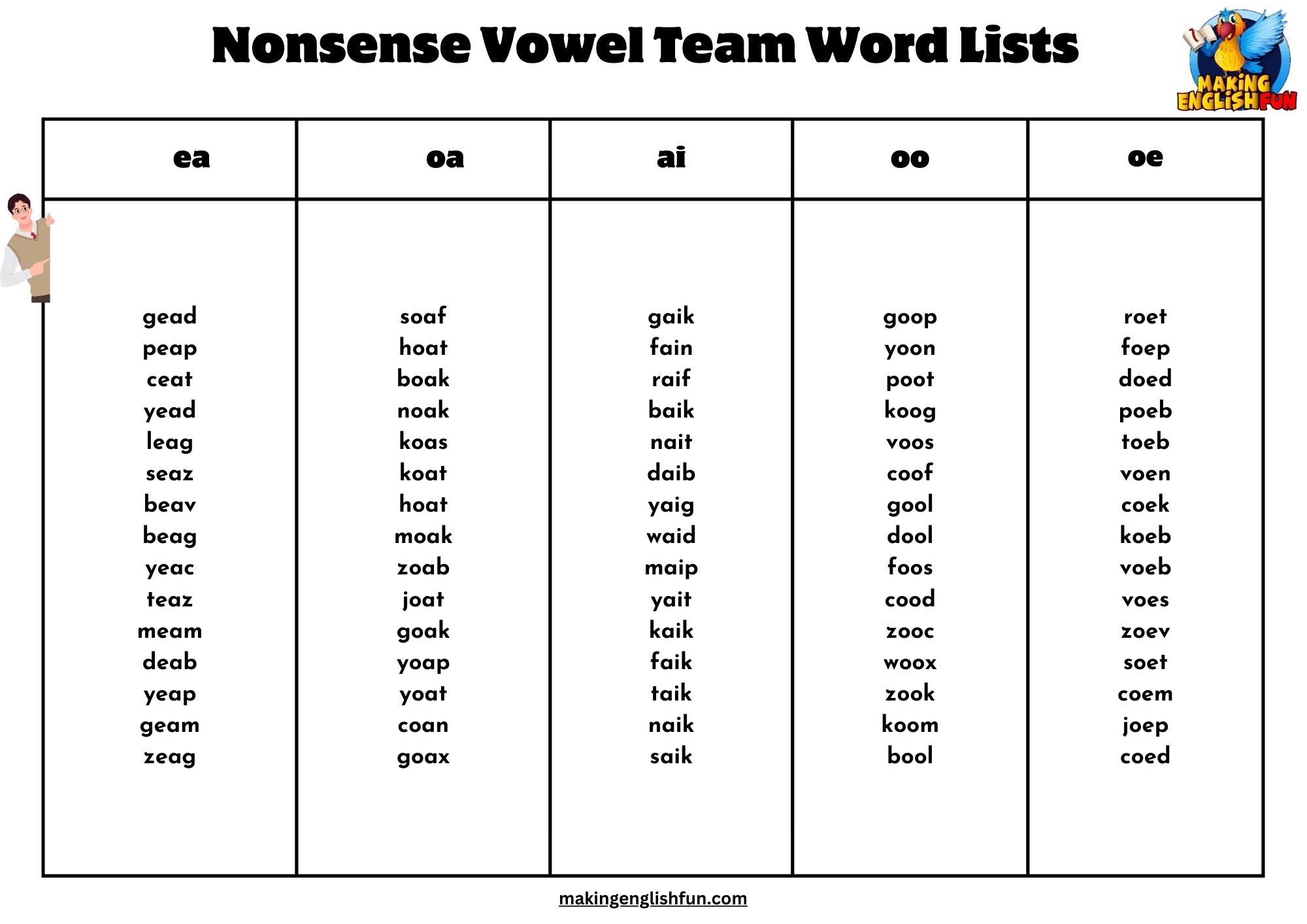
75 Vowel Team Nonsense Word List
This table of nonsense words with vowel teams (ea, oa, ai, oo, oe) is an excellent tool for teaching vowel sounds and their combinations.

Vowel teams are pairs of vowels that work together to produce a single sound, and they are a significant component of advanced phonics.
Understanding vowel teams is vital for students as it aids in decoding a large portion of the English language, especially multisyllabic words.
| ea | oa | ai | oo | oe |
|---|---|---|---|---|
| gead | soaf | qaik | goop | roet |
| peap | hoat | fain | yoon | foep |
| ceat | boak | raif | poot | doed |
| yead | noak | baik | koog | poeb |
| leag | koas | nait | voos | toeb |
| seaz | koat | daib | coof | voen |
| beav | hoat | yaig | gool | coek |
| beag | moak | waid | dool | koeb |
| yeac | zoab | maip | foos | voeb |
| teaz | joat | yait | cood | voes |
| meam | goak | kaik | zooc | zoev |
| deab | yoap | faik | woox | soet |
| yeap | yoat | taik | zook | coem |
| geam | coan | naik | koom | joep |
| zeag | goax | saik | bool | coed |
75 R Controlled Vowel Nonsense Words
This Table includes R Controlled nonsense words, is ideal for phonics practice. Each column focuses on a different R-controlled sound (ar, er, ir, or, ur).

R-controlled sounds occur when a vowel is followed by an ‘r’, leading to a unique sound distinct from the long and short vowel sounds.
Words with these sounds can be tricky for learners, hence the importance of our table featuring R-controlled nonsense words (ar, er, ir, or, ur).
| ar | er | ir | or | ur |
|---|---|---|---|---|
| jark | jern | kirt | horp | kurp |
| garf | herf | virm | gorj | murf |
| garv | terl | rird | worz | furp |
| karc | rerd | nirl | forn | hurn |
| parp | cerd | mird | tork | surk |
| tarm | werk | jirt | torp | vurg |
| lart | perd | virp | korf | lurf |
| zark | rert | pirl | vorj | nurp |
| narb | berf | rirp | hort | wurf |
| darf | terp | kirm | xorv | gurt |
| darp | cerz | dirp | borl | jurt |
| yart | perg | mirb | zorb | murp |
| barm | werm | pirz | vors | zurf |
| tard | gerf | virt | wors | turb |
| barp | gerp | cirk | worg | gurb |
45 Multiple Syllable Nonsense Words
With 2, 3, and 4 syllable nonsense words, this resource challenges learners to break down complex word structures, promoting a deeper grasp of syllabic patterns and phonic awareness.

As learners advance in their phonics skills, introducing multisyllabic nonsense words becomes important.
These words, comprising two, three, or even four syllables, challenge students to apply their phonetic skills across longer and more complex word structures.
This practice is crucial in developing their ability to decode unfamiliar words they will encounter in their reading journey. Also they are fun to try to sound out!
| 2-syllable | 3-syllable | 4-syllable (for fun) |
|---|---|---|
| hefi | vekitu | dudidono |
| bofo | fayale | fidijipo |
| pomo | fawecmon | gejolesky |
| yevo | xekuko | ketazari |
| boja | vaqila | zutebeva |
| vehe | hahaku | cogukure |
| wohu | nuhupe | tujalafa |
| jiju | qufuya | nuzetako |
| detu | fatepo | fucubipu |
| mozo | hohamu | furefesitom |
| wubo | mukonu | gibakeho |
| tivu | tobohi | takojevu |
| nini | fupeti | vilakipa |
| ripa | vahobo | hahidaro |
| loza | kiquvi | wodinaku |
The Role of Nonsense Words in Phonics Learning
Nonsense words, the seemingly odd strings of letters, play a surprisingly crucial role in phonics education.
By removing the chance of rote memory recall, nonsense words offer a true assessment of a child’s phonemic awareness.
They require students to rely on their understanding of sound-letter correspondences, which is fundamental in early reading development.
You can Check out our full Worksheet, Games and Activities bundle on the image below

Teaching Aids: How to Use These Nonsense Word Lists:
Nonsense word lists are an excellent resource in a variety of educational settings.
Here’s an look at some effective strategies for their use:
- Phonics Drills: Regular phonics drills are essential in reinforcing decoding skills. Use the lists to have students practice decoding each word aloud. This can be done in a classroom setting or at home, with students focusing on enunciating each sound clearly. This practice helps in cementing sound-letter associations and improves pronunciation skills.
- Games: Integrating nonsense words into games is a fantastic way to make learning engaging and interactive. For instance:
- ‘Word Bingo’: Create bingo cards with nonsense words, and as you call out the words, students mark them on their cards. This game is excellent for recognizing and recalling sounds.
- ‘Memory Match’: Use pairs of cards with nonsense words, and have students find matching pairs. This not only reinforces phonics skills but also aids in memory development.
- Assessment: These lists serve as invaluable tools for conducting informal assessments of students’ phonics skills. Teachers can use them to evaluate a student’s ability to apply phonetic rules in reading. This can be done through oral reading sessions or written tests, providing insights into areas where a student might need more practice.
When playing classroom games, using special prop aids can add some personalization to your interactions.
Specially Custom Poker Chips, for example, can incorporate elements that students love. Such as cartoon images, pop culture symbols, etc., which can inspire students to participate in the game.
Meaningless words can also be written on them and used to interact with them, which can inspire students to participate. Not only does it increase the fun of the game it also increases knowledge acquisition.

- Writing Exercises: Encourage students to use nonsense words in creative writing exercises. This not only reinforces their understanding of phonetic rules but also stimulates their imagination and creativity. For example, students could write short stories or poems using a set number of nonsense words, challenging them to incorporate these words meaningfully into their writing.
- Group Activities: Organize group activities where students teach each other new words from the list. This peer-to-peer learning approach can be highly effective, as students often learn well from their contemporaries. Such activities can include group reading sessions, where each student reads a word and the others repeat it, or group projects where teams use the words to create a story or a skit.
- Interactive Whiteboard Activities: For classrooms equipped with interactive whiteboards, teachers can create engaging exercises where students drag and drop letters to form nonsense words. This can be turned into a timed challenge, adding an element of excitement to the learning process.
- Sound Sorting: Provide students with a mix of nonsense words from the lists and ask them to categorize them based on their phonetic features, like vowel sounds or consonant blends. This activity is excellent for developing analytical skills and a deeper understanding of phonetic patterns.
- Focused Decoding Practice: Use the lists for targeted decoding practice. This could involve having students identify individual sounds in words or use their knowledge of phonics rules to decode complex words, enhancing their reading fluency.
- Regular Assessment for Skill Development: Implement these lists in regular assessments to monitor and encourage the development of phonics skills. These assessments can be varied, from reading aloud to written exercises, providing continuous feedback on student progress.
Conclusion
The use of nonsense words in phonics instruction is a powerful and effective method for teaching reading skills.
By focusing on words that have no inherent meaning, educators can ensure that students are genuinely applying phonetic principles rather than relying on memory.
The various tables and lists provided in this article, covering everything from simple CVC words to complex consonant blends and digraphs, offer a rich resource for educators to draw upon.
Further Resources
- https://bhm.link75.org/common/pages/DisplayFile.aspx?itemId=802187
- https://www.thephonicspage.org/On%20Reading/Resources/NonsenseWordsByType.pdf
- https://cdn.thisreadingmama.com/wp-content/uploads/2017/06/NSWL-TRM.pdf
- https://wps.asd.k12.pa.us/apps/pages/index.jsp?uREC_ID=597066&type=u&pREC_ID=2031188