What Are The Six Syllable Types?
Understanding the different types of syllables is crucial for both reading and spelling. Each syllable type follows specific patterns that influence how a word is pronounced and often how it is spelled.
Mastering these syllable types not only aids in decoding complex words but also significantly enhances overall literacy skills.
The six syllable types in English are: Closed, Open, Vowel-Consonant-e (VCe), Consonant-l-e (Cle), R-Controlled, and Vowel Team syllables. Some Linguistic experts suggest that there is an often-included seventh type, Diphthongs.
As teachers, familiarizing ourselves with these syllable types helps us to better support our students in their journey to becoming proficient readers and writers.

You can download the 6 types of syllable and a table for students at the end of the article.
The Concept of Syllable Types
A syllable is a single, unbroken unit of sound in a word, one of the essential building blocks of language. Syllables give structure to words and contribute to their pronunciation.
In the English language, there are six primary syllable types, each with its unique pattern and rule.
Understanding these syllable types is key to grasping the rhythmic and phonetic nature of English, providing a systematic approach to reading and spelling.
What are the Six Syllable types?
This guide to English Syllable types looks into the six primary syllable types—closed, open, VCe, Cle, r-controlled, vowel teams, and the often-included seventh type, diphthongs.
We also have printable lists of these types with examples you can access at the end of each type, and the end of the article for more syllable downloads.
1. Closed Syllables
What is a Closed Syllable?
Closed syllables are the most common syllable type in English. They consist of one vowel followed by one or more consonants, resulting in a short vowel sound.

The consonant ‘closes in’ on the vowel, creating this short sound. This syllable type is foundational in understanding English spelling and pronunciation.
| Examples | |||
|---|---|---|---|
| cat | ham | web | dish |
| rob | fist | trap | blend |
Introduction in Learning
Closed syllables should be introduced early in reading instruction as they form the basis for many simple words that young readers first encounter.
They are crucial for building phonemic awareness and decoding skills in beginner readers.
2. Open Syllables
What is an Open Syllable?
Open syllables end in a vowel, which typically makes a long sound, as the syllable remains ‘open’.
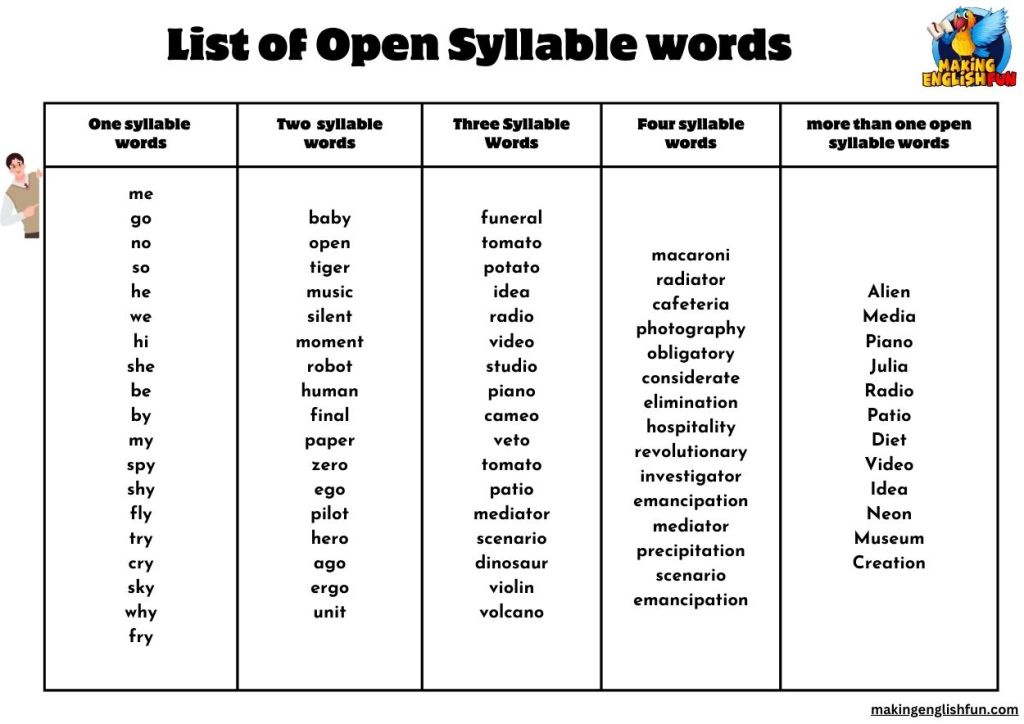
These syllables are vital for understanding how vowels can change their sounds, especially in multisyllabic words.
| Examples | |||
|---|---|---|---|
| he | go | no | she |
| we | hi | so | by |
Introduction in Learning
Open syllables are less common than closed syllables but still frequently appear in English.
They should be introduced after students have a firm grasp of closed syllables, to help them understand the contrast between short and long vowel sounds.
3. Vowel-Consonant-e (VCe) Syllables

What is a Vowel-Consonant-e Syllable?
VCe syllables, often known as ‘silent e’ syllables, are characterized by a vowel followed by a consonant and a silent ‘e’.
This silent ‘e’ changes the vowel’s sound to its long form. VCe syllables are integral in teaching students about vowel behavior in different contexts.
| Examples | |||
|---|---|---|---|
| cake | stripe | note | mule |
| dine | skate | cube | plate |
Introduction in Learning
VCe syllables are common in English and should be introduced once students are comfortable with both closed and open syllables.
They help students understand how the presence of a silent ‘e’ can alter vowel sounds, a key concept in English spelling.
4. Consonant-l-e (Cle) Syllables

What is a Consonant-l-e Syllable?
Consonant-l-e syllables, typically found at the end of words, consist of a consonant followed by ‘le’.
The vowel sound in these syllables is usually a brief ‘ul’ sound. Cle syllables are essential for understanding how word endings affect pronunciation and spelling.
| Examples | |||
|---|---|---|---|
| table | simple | little | bubble |
| candle | castle | puzzle | juggle |
Introduction in Learning
Consonant-l-e syllables are relatively less common but still important in English.
They should be introduced after the basic syllable types to enhance students’ understanding of word endings and their impact on word structure.
5. R-Controlled Syllables

What is an R-Controlled Syllable?
In r-controlled syllables, a vowel is followed by the letter ‘r’, which alters the vowel’s sound.
The vowel does not make its usual short or long sound but rather a unique sound influenced by the ‘r. These syllables are crucial in teaching the complexities of vowel sounds.
| Examples | |||
|---|---|---|---|
| car | star | her | bird |
| fur | corner | sir | order |
Introduction in Learning
R-controlled syllables are quite common in English.
They should be taught after students have a good understanding of other syllable types, particularly open and closed syllables, to help them grasp the nuanced sounds of vowels influenced by ‘r’.
6. Vowel Team (Vowel Digraph) Syllables
What is a Vowel Team Syllable?
Vowel team syllables contain two adjacent vowels that together create a single sound.
Often, the first vowel is the one that is pronounced, but there are exceptions. These syllables demonstrate the complexity of vowel pairings and their impact on pronunciation.
| Examples | |||
|---|---|---|---|
| boat | team | rain | meet |
| pie | bread | food | book |
Introduction in Learning
Vowel team syllables are a common feature in English, especially in more advanced vocabulary.
They should be introduced after students are comfortable with single-vowel syllables, to further develop their understanding of complex vowel sounds.
7. Diphthong Syllables
What is a Diphthong Syllable?
Diphthong syllables contain a complex vowel sound formed by the combination of two vowels within the same syllable, creating a glide from one vowel sound to another.
They are sometimes viewed as a distinct syllable type due to their unique sound transitions, which differ from typical vowel team syllables.
| Examples | Examples | ||
|---|---|---|---|
| boil | coin | loud | house |
| owl | crowd | soil | mouse |
Introduction in Learning
Diphthong syllables, while not universally classified as a separate syllable type, are important in English and can be introduced once students are familiar with vowel teams.
They help students understand the subtleties of vowel sounds and are crucial for accurate pronunciation and spelling in more advanced vocabulary.
You can download the six syllables types resources for teachers and students using the links below. We have more syllable resources in the next section too.
How and When to Teach Syllable Types
Teaching syllable types effectively requires a structured and sequential approach, which aligns with a student’s overall reading and language development.
Understanding when and how to introduce each syllable type is key to ensuring that students grasp these concepts thoroughly.
Introducing Syllable Types
- Start with Closed Syllables: Begin instruction with closed syllables, as they are the most basic and frequent syllable type. They provide a foundation for understanding how consonants can influence vowel sounds. Closed syllables can be introduced as soon as students start learning to read.
- Progress to Open Syllables: Once students are comfortable with closed syllables, introduce open syllables to contrast the long vowel sounds. This helps students understand the variability in vowel pronunciation.
- Introduce Vowel-Consonant-e (VCe): After mastering open and closed syllables, introduce VCe syllables to demonstrate how a silent ‘e’ can change a vowel’s sound. This is crucial for developing an understanding of vowel variations.
- Move to R-Controlled and Vowel Teams: These more complex syllable types can be introduced as students become more confident readers. R-controlled and vowel team syllables introduce students to the nuances of vowel sounds influenced by surrounding letters.
- Conclude with Consonant-l-e (Cle) and Diphthongs: These advanced syllable types are best taught once students have a solid understanding of other syllable types. They cover more complex word structures and vowel combinations.
We have a selection of top resources for syllables and the teaching of syllables here on the site. We have listed some below for you these are in addition to the table download on this page.
Syllable Teaching Resources
- How to teach Syllables
- Editable Syllables worksheets and Answer keys
- 80+ Closed Syllable words list
- 80+ Open Syllable words list
- The Best Free Online Syllable Games
- Free Syllables Worksheets
Effective Teaching Strategies
- Use Multisensory Activities: Incorporate visual, auditory, and kinesthetic learning activities. This can include syllable sorting games, word-building exercises, and interactive reading sessions.
- Provide Practical Examples: Use word lists and real-life reading materials to demonstrate each syllable type. Contextual learning helps solidify understanding.
- Reinforce with Worksheets and Games: Utilize available resources such as worksheets and educational games to practice syllable types. These can be integrated into regular lessons or used for additional practice.
- Continual Review and Practice: Regularly revisit each syllable type to reinforce learning. Use a mix of new and familiar words to keep students engaged and challenged.
- Tailor Instruction to Student Needs: Be prepared to adjust the pace and focus based on individual student progress and comprehension.
By following this structured approach and utilizing a variety of teaching methods, educators can effectively guide students through learning the different syllable types.
Conclusion
In summary, the six syllable types form the foundation of effective reading and spelling instruction.
By understanding and teaching these syllable patterns, educators can provide students with the tools they need to tackle the challenges of English pronunciation and spelling.
This knowledge not only aids in decoding and comprehending words but also builds a solid foundation for lifelong literacy.
As we incorporate these syllable types into our teaching, we open up a world of words to our students, enabling them to read and write with confidence and skill.
Further reading
- https://www.una.edu/education/educator-preparation/praxis-resources/Six%20Syllable%20Types.pdf
- https://learningattheprimarypond.com/blog/the-6-syllable-types-what-they-are-why-they-matter-and-when-to-teach-them/
- https://files.eric.ed.gov/fulltext/EJ1291185.pdf
- https://thriveedservices.com/the-6-types-of-syllables/
Making English Fun!

I have been a teacher of English for over 15 years, in that time i made hundreds and thousands of resources and learnt so much i think its worth sharing. Hopefully to help teachers and parents around the world.