20 + English Food Idioms to Improve Your English | With Printables
Introduction
Welcome to a feast of expressions! Food idioms are some of the most flavorful elements of the English language, offering a taste of cultural history and everyday life.
From a “piece of cake” to “spilling the beans,” these idioms pepper our conversations with zest and fun. Whether you’re a language learner or a seasoned speaker, understanding these English Food idioms can help you communicate more vividly and connect with others over the universal experience of eating.
Join us as we explore the rich tapestry of food idioms and how they can add flavor to your language skills.

The Role of Food Idioms in English
Food is a central part of human experience, and naturally, it finds its way into our language. Food idioms convey more than just culinary concepts; they express ideas of simplicity, difficulty, secrecy, and many other aspects of daily life.
These expressions provide a relatable way to describe complex emotions and situations through the familiar context of food, making them particularly memorable and engaging.
Cultural Significance:
Every culture has its own set of food-related expressions, and learning these can provide insights into the values and history of the culture.
English food idioms often come from historical dining habits and societal norms, reflecting the importance of food in social and familial settings.
Expressiveness and Vividity:
Using food idioms can enrich your language, making descriptions more vivid and expressive.
When you say someone “brings home the bacon,” you instantly invoke a sense of provision and success, rooted in the historical importance of bacon as a staple food.
Versatility:
Food idioms are versatile and can be used in a variety of contexts, from formal business meetings to casual chats with friends.
They add color and personality to the conversation, making your speech more engaging and relatable.
Let’s dig into some popular food idioms, their meanings, and their origins, and discover how you can incorporate them into your daily conversations.
Detailed Exploration of English Food Idioms
Food idioms bring a deliciously descriptive layer to everyday English, illustrating common life situations with terms that everyone can relate to, much like food itself.
These idioms serve not only as tools for effective communication but also enrich the language by adding cultural flavor and historical depth.
Whether discussing business strategies or personal experiences, using food idioms correctly can enhance clarity and add a touch of creativity to your interactions.
Let’s continue to explore some savory expressions that can help you express ideas more vividly.
Eat Humble Pie
Admitting wrongs or accepting humiliation isn’t pleasant, akin to eating a less desirable dish. This idiom is useful for moments requiring humility and apology.
| Food Idiom | Definition | Example | Origin |
|---|---|---|---|
| Eat humble pie | To admit error and apologize for a mistake. | “After the misunderstanding, he had to eat humble pie and apologize to his team.” | Originates from the term ‘umbles’ pie, which was a pie filled with the less appetizing parts of the deer. |
In a Nutshell
When you need to summarize complex information succinctly, using “in a nutshell” conveys brevity and clarity, much like compressing a large idea into a small, compact nutshell.
| Food Idiom | Definition | Example | Origin |
|---|---|---|---|
| In a nutshell | Summarized very briefly. | “To put it in a nutshell, we are failing to meet our sales targets.” | Likely stemming from ancient times, when lengthy works were said to be condensed small enough to fit into a nutshell. |
Spill the Beans
Revealing secrets or spilling confidential information can disrupt plans or reveal surprises, much like spilling beans unexpectedly scatters them out of a bag.
| Food Idiom | Definition | Example | Origin |
|---|---|---|---|
| Spill the beans | To reveal secret information accidentally or prematurely. | “He spilled the beans about the surprise party, ruining the plan.” | From ancient Greek society, where beans were used to vote anonymously; spilling them could reveal the otherwise secret votes. |

Butter Someone Up
Flattering someone to gain favor is akin to spreading butter on bread, making it more appealing and soft. This idiom captures the essence of enhancing one’s appeal through praise.
| Food Idiom | Definition | Example | Origin |
|---|---|---|---|
| Butter someone up | To flatter someone excessively, usually to gain a favor. | “She buttered up her boss before asking for a day off.” | Likely derived from ancient Indian custom of throwing balls of clarified butter at statues of the gods to seek favor. |
Full Plate
Having a lot to do can be overwhelming, much like a plate overloaded with food.
This idiom is used to describe busy schedules or large amounts of responsibilities.
| Food Idiom | Definition | Example | Origin |
|---|---|---|---|
| Full plate | To have many responsibilities or be very busy. | “I can’t take on another project; I’ve got a full plate already.” | Reflecting the idea of having so much food on your plate that you can’t possibly manage any more. |

Big Cheese
In any group or organization, the “big cheese” is someone extremely important or influential, often the boss or a key figure.
The term suggests that like a large wheel of cheese, this person holds substantial weight and value.
| Food Idiom | Definition | Example | Origin |
|---|---|---|---|
| Big cheese | An important or influential person, especially in an organization. | “Everyone listens when the big cheese talks; she’s very influential in the industry.” | Derived from early 20th-century U.S. slang, where “cheese” was synonymous with quality and importance, likely inspired by the phrase “the cheese” from Urdu “chiz” meaning “thing.” |

Cherry on Top
Adding a “cherry on top” refers to making something good even better, just as a cherry tops off an already delightful dessert.
It’s typically used to describe a small, final addition that perfects the whole.
| Food Idiom | Definition | Example | Origin |
|---|---|---|---|
| Cherry on top | An additional benefit or enhancement that perfects something. | “Getting the job was great, and the signing bonus was the cherry on top.” | Likely coming from the early practice of serving desserts with a cherry on top as a final, decorative touch that enhances the appeal. |

Cream of the Crop
This idiom signifies the best of a group, similar to cream rising to the top of milk as the richest part.
It’s often used to denote people or things considered superior within a certain context.
| Food Idiom | Definition | Example | Origin |
|---|---|---|---|
| Cream of the crop | The best of a particular group. | “These students are the cream of the crop; they’ve surpassed all expectations this semester.” | Originates from the farming practice where the “cream” literally refers to the best part of the milk, symbolizing top quality. |
Hard Nut to Crack
A “hard nut to crack” refers to a problem that is very difficult to solve or a person who is tough to understand.
Just like cracking a tough shell to get to the nut, these challenges require extra effort and persistence.
| Food Idiom | Definition | Example | Origin |
|---|---|---|---|
| Hard nut to crack | A difficult problem to solve or a person who is hard to understand. | “The new software system was a hard nut to crack, but we finally figured it out.” | Coming from the literal difficulty of cracking open hard-shelled nuts, the phrase has been used metaphorically since at least the 18th century. |
Walk on Eggshells
To “walk on eggshells” means to be extremely cautious about one’s actions or words, especially around someone who is easily upset or offended.
It conveys the idea of treading lightly to avoid damage or conflict.
| Food Idiom | Definition | Example | Origin |
|---|---|---|---|
| Walk on eggshells | To be very careful about how one acts or what one says. | “Since the argument, I’ve been walking on eggshells around her.” | The imagery of walking carefully to avoid crushing fragile eggshells effectively illustrates the need for delicacy in sensitive situations. |

Salt of the Earth
Referring to someone as the “salt of the earth” implies that they are humble, honest, and unpretentious.
This idiom celebrates the fundamental virtues of a person, much like salt is a basic and essential seasoning in cooking.
| Food Idiom | Definition | Example | Origin |
|---|---|---|---|
| Salt of the earth | A person who is humble, reliable, and fundamental to society. | “My grandmother was the salt of the earth, always helping others without seeking credit.” | Derived from the Bible (Matthew 5:13), where Jesus refers to his disciples as the “salt of the earth,” indicating their value in upholding moral standards. |
Bring Home the Bacon
To “bring home the bacon” means to earn a living, particularly for one’s family, and implies successful achievement.
Historically, bacon was a valuable and desirable commodity, (its still is!!!) making the ability to bring it home a sign of prosperity.
| Food Idiom | Definition | Example | Origin |
|---|---|---|---|
| Bring home the bacon | To earn money for a family or household. | “He’s been working two jobs to bring home the bacon.” | Dates back to the 12th century when a church in England offered a side of bacon to any man who could swear before God and the congregation that he had not quarreled with his wife for a year and a day. |

The Proof is in the Pudding
This idiom asserts that the real value or quality of something can only be judged through practical experience and not by appearance or theory alone. It underscores the importance of outcomes and final results.
| Food Idiom | Definition | Example | Origin |
|---|---|---|---|
| The proof is in the pudding | The true value or quality of something can only be judged through experience. | “They claimed that the new software would speed up processing, but the proof is in the pudding.” | Adapted from a longer phrase, “The proof of the pudding is in the eating,” which dates back to at least the 14th century, emphasizing that one must try food |
As Cool as a Cucumber
To be “as cool as a cucumber” means to remain calm and composed, even in stressful situations, much like the cool, refreshing nature of cucumbers.
| Food Idiom | Definition | Example | Origin |
|---|---|---|---|
| As cool as a cucumber | To remain calm and untroubled, especially in stressful situations. | “Even during the heated meeting, she was as cool as a cucumber.” | Likely derives from the fact that cucumbers tend to remain cooler on the inside than the air around them, hence their association with coolness and calm demeanor. |
Full of Beans
Someone who is “full of beans” is lively, energetic, and enthusiastic.
This idiom likely reflects the once-believed idea that beans are highly nutritious and energizing.
| Food Idiom | Definition | Example | Origin |
|---|---|---|---|
| Full of beans | To be energetic and enthusiastic. | “After his morning coffee, he’s always full of beans.” | While the exact origin is unclear, it’s thought to stem from the early 20th century, potentially from horse feed practices where beans were thought to be particularly energizing. |
Egg on Your Face
Having “egg on your face” means to be embarrassed or to look foolish, usually as a result of something one has done.
This idiom paints a vivid picture of someone with literal egg remnants on their face after an unsuccessful endeavor.
| Food Idiom | Definition | Example | Origin |
|---|---|---|---|
| Egg on your face | To appear foolish or be embarrassed by one’s actions. | “He had egg on his face after boasting he could easily do the repairs, only to fail miserably.” | Likely derived from the slapstick comedy trope where a character gets hit in the face with an egg, leading to public embarrassment. |
That’s the Way the Cookie Crumbles
This idiom expresses resignation or acceptance towards the way events have unfolded, usually those beyond one’s control.
It reflects an understanding that not all outcomes can be predicted or managed, much like the unpredictable breaking of a cookie.
| Food Idiom | Definition | Example | Origin |
|---|---|---|---|
| That’s the way the cookie crumbles | Used to express acceptance of the outcome of a situation. | “I didn’t get the job, but that’s just the way the cookie crumbles.” | Originates from the 20th-century American English, directly relating to the random and often uncontrollable way a cookie might break apart. |
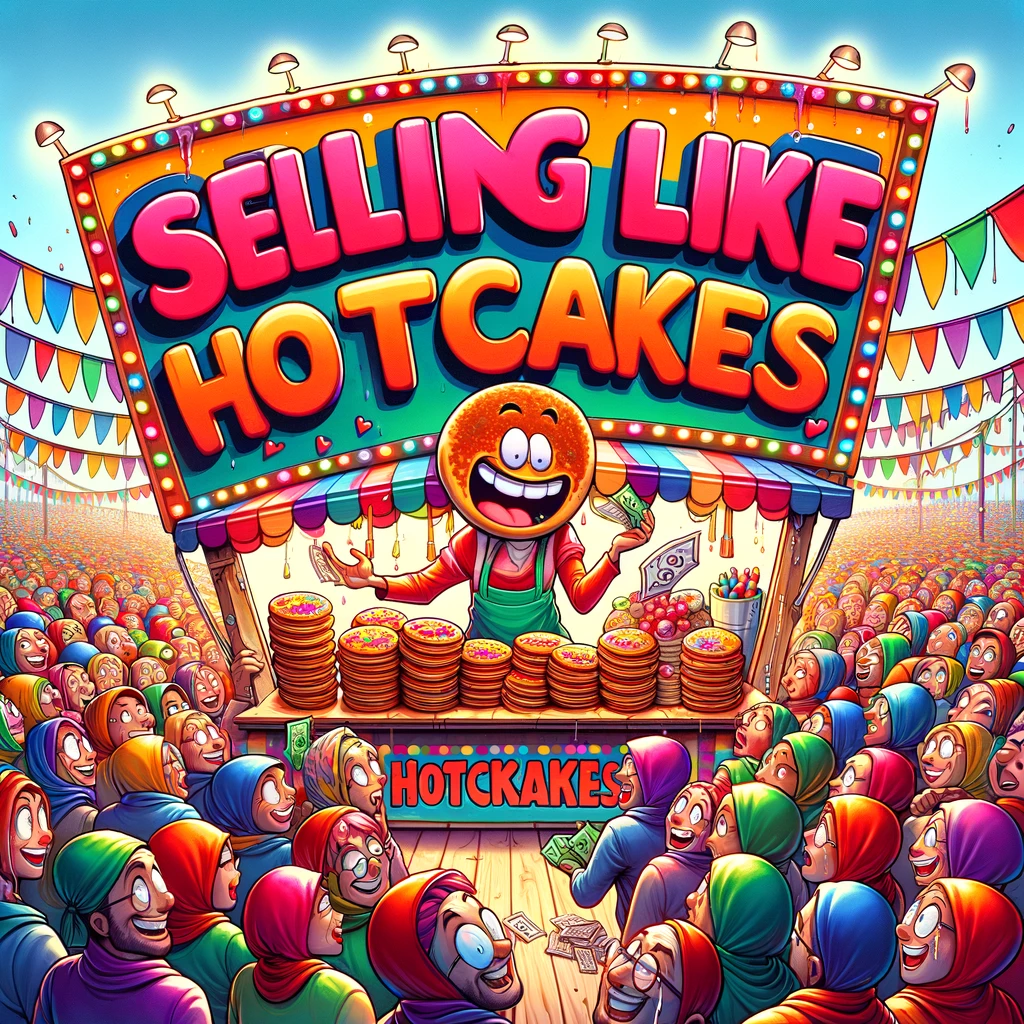
Sell Like Hotcakes
When something “sells like hotcakes,” it means it is being sold very quickly and in large quantities, akin to the popularity and fast-selling nature of hotcakes at events.
| Food Idiom | Definition | Example | Origin |
|---|---|---|---|
| Sell like hotcakes | To sell quickly and in large quantities. | “As soon as the new model hit the shelves, it started selling like hotcakes.” | Comes from the United States in the 19th century, where hotcakes (pancakes) were a popular and quickly sold item at fairs and other events. |
Spicing Things Up
To “spice things up” means to add excitement or variety to a situation or activity, enhancing the ordinary or mundane through additional, often flavorful, elements.
| ** Food Idiom** | Definition | Example | Origin |
|---|---|---|---|
| Spicing things up | To add excitement or variety to make something more interesting. | “We decided to spice things up in our weekly meetings by introducing creative brainstorming sessions.” | Derived from the culinary use of spices to enhance the flavor and appeal of food, metaphorically extending to any effort to make something more interesting or exciting. |
Chew the Fat
“Chew the fat” means to engage in casual conversation, especially involving sharing stories or discussing mundane matters.
It suggests a leisurely pace, similar to how one might slowly chew fatty meat.
| Food Idiom | Definition | Example | Origin |
|---|---|---|---|
| Chew the fat | To engage in casual or leisurely conversation. | “Let’s chew the fat over coffee tomorrow morning.” | Believed to originate from the historical practice of sailors, who while chewing on salt-hardened fat, would talk to pass the time during long voyages. |
Cry Over Spilt Milk
To “cry over spilt milk” means to lament or complain about something that has already happened and cannot be changed.
It encourages focusing on the present and future rather than dwelling on past mistakes or misfortunes.
| Food Idiom | Definition | Example | Origin |
|---|---|---|---|
| Cry over spilt milk | To be upset about something that cannot be undone. | “He forgot to save the document, but there’s no use crying over spilt milk now.” | This idiom dates back to at least the 1650s and is used universally to denote wasted regrets over past actions that cannot be altered. |
Use Your Noodle
“Use your noodle” is an informal way of telling someone to think carefully or use their brain. The term “noodle” here is a playful synonym for the head or mind, emphasizing the need for thoughtful consideration.
| Food Idiom | Definition | Example | Origin |
|---|---|---|---|
| Use your noodle | To think intelligently or make sensible decisions. | “You’re going to have to really use your noodle to solve these complex puzzles.” | “Noodle” as slang for head or brain dates back to the late 18th century, deriving from the German ‘nudel’, which means fool. |
Bread and Butter
“Bread and butter” signifies one’s basic needs or source of sustenance, often referring to someone’s main income stream.
This idiom highlights essentials, much like bread and butter represent fundamental nourishment.
| Food Idiom | Definition | Example | Origin |
|---|---|---|---|
| Bread and butter | One’s primary source of income or fundamental necessities. | “Tourism is the bread and butter of this town.” | The phrase originates from the historical importance of bread and butter as staple foods in many cultures, symbolizing basic sustenance. |
We also have other pages dedicated to idioms here on the site you can access them from the list below.
- Working Hard English Idioms
- English Food Idioms
- English Animal Idioms
- English Color Idioms
- English Sports Idioms
Conclusion
Through this delicious journey into the world of food idioms, we’ve seen how these expressions enrich our language with flavor and zest.
Each idiom offers a unique perspective on everyday situations, making our conversations more engaging and relatable.
As we integrate these idioms into our speech, we not only become more fluent English speakers but also connect more deeply with the rich cultural tapestry that language offers.
Making English Fun!

I have been a teacher of English for over 15 years, in that time i made hundreds and thousands of resources and learnt so much i think its worth sharing. Hopefully to help teachers and parents around the world.