Vicious or Visious: Which is the Correct Spelling?
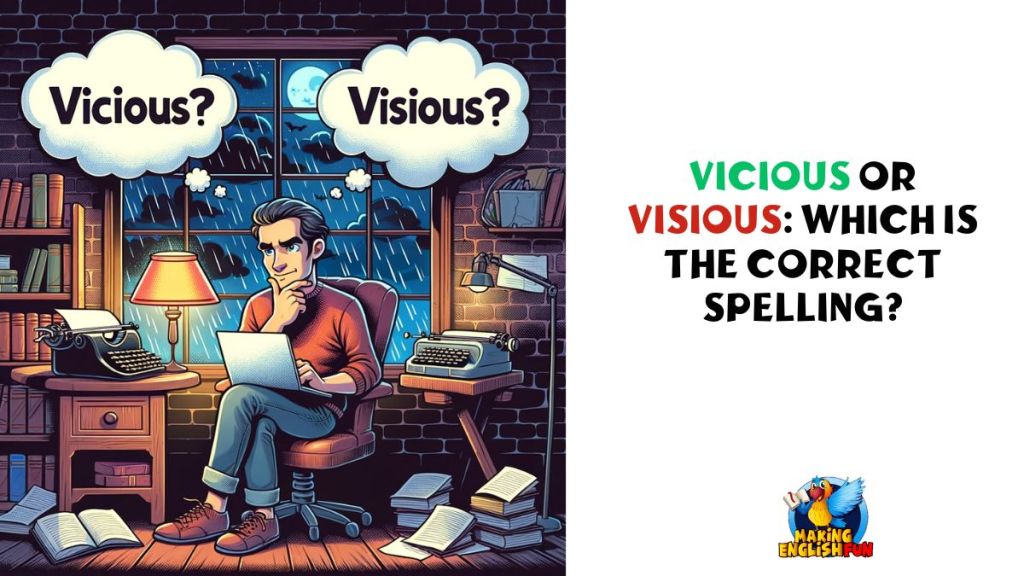
English spelling can be Vicious, or is that Visious! We take a look at how to spell this word below.
“Vicious,” can often be misspelled as “Visious.” The correct spelling is essential for clear communication, especially in contexts where discussing aggressive, harmful, or morally reprehensible behaviors or actions.
This article aims to clarify the correct spelling of “vicious” and provide insights to help you remember and use it accurately, whether you’re writing descriptive texts, discussing character traits, or using the term in psychological contexts.
Correct Spelling and Definition
The correct spelling is “Vicious,” with ‘ci’ after the ‘v’.
“Vicious” refers to deliberately cruel or violent behavior.
It can also describe actions or conditions that are dangerously aggressive. For example, “The debate turned vicious with personal attacks.”
Common Spelling Error: Visious
The incorrect spelling “Visious,” with ‘si’ instead of ‘ci’, is a frequent mistake.
This error might stem from an incorrect phonetic interpretation or a misapprehension of the word’s structure.
However, the accurate spelling is “Vicious,” which correctly reflects its etymology and standard usage in English.
Comparison with Other Common Spelling Confusions
Like “Vicious,” there are other words in English that often get misspelled.
Here’s a comparison table showcasing some common spelling challenges:
| Correct Spelling | Common Incorrect Spelling |
|---|---|
| Vicious | Visious |
| Necessary | Neccessary, Necesary |
| Conscience | Consciense |
| Conscious | Conscous |
| Miscellaneous | Miscellanous |
This table emphasizes the importance of understanding and memorizing the correct spellings of commonly used words.
Etymology and Historical Development
“Vicious” comes from the Latin “vitiosus,” meaning ‘faulty, full of faults’ or ‘corrupt.’
The form “Vicious” in English, with ‘ci’, has been consistent over time, reflecting the word’s Latin roots and its adoption into Middle English.
Usage in Different Contexts
“Vicious” is used in various fields and contexts.
- In psychology and social discussions, it refers to harmful or aggressive behaviors.
- In literary and journalistic writing, it’s used to describe intense or damaging actions.
Accurate use of “vicious” in these contexts is important for clear and precise communication.
Tips for Remembering the Correct Spelling
To remember the correct spelling of “Vicious,” associate the ‘ci’ with ‘cruel intentions,’ reflecting the word’s meaning.
Regular reading and writing in diverse contexts, especially those involving behavioral descriptions, can reinforce the correct spelling.
Conclusion
Understanding and correctly using the word “Vicious” is essential for effective communication in various professional, academic, and everyday settings.
Accurate spelling not only ensures clarity but also reflects a strong command of the English language and an understanding of complex behaviors.
Extended FAQs and Reader Questions
- How can I improve my spelling of complex English words like ‘Vicious’?
- Engage in regular reading, writing, and use educational tools to enhance your spelling skills for complex English words.
- Are there digital tools that assist with English spelling and vocabulary?
- Yes, various spelling and grammar checkers, educational apps, and online resources offer tools for learning and improving spelling and vocabulary.
- Why is correct spelling important in descriptive and psychological writing?
- In descriptive and psychological writing, correct spelling is crucial for maintaining the accuracy, clarity, and impact of the narrative or analysis.
- Do native English speakers often make spelling errors in words like ‘Vicious’?
- Yes, such errors can occur, particularly in words with spelling that doesn’t directly align with their pronunciation.
- Can incorrect spelling affect the interpretation of character analyses or psychological profiles?
- Yes, misspelling key terms can lead to misunderstandings or misinterpretations in character analyses or psychological assessments.
Further Resources
- https://www.grammar.com/vicious_vs._viscous#:~
- https://grammarist.com/spelling/vicious-viscous/
- https://word.tips/spelling/vicious-vs-viscious/
Making English Fun!

I have been a teacher of English for over 15 years, in that time i made hundreds and thousands of resources and learnt so much i think its worth sharing. Hopefully to help teachers and parents around the world.