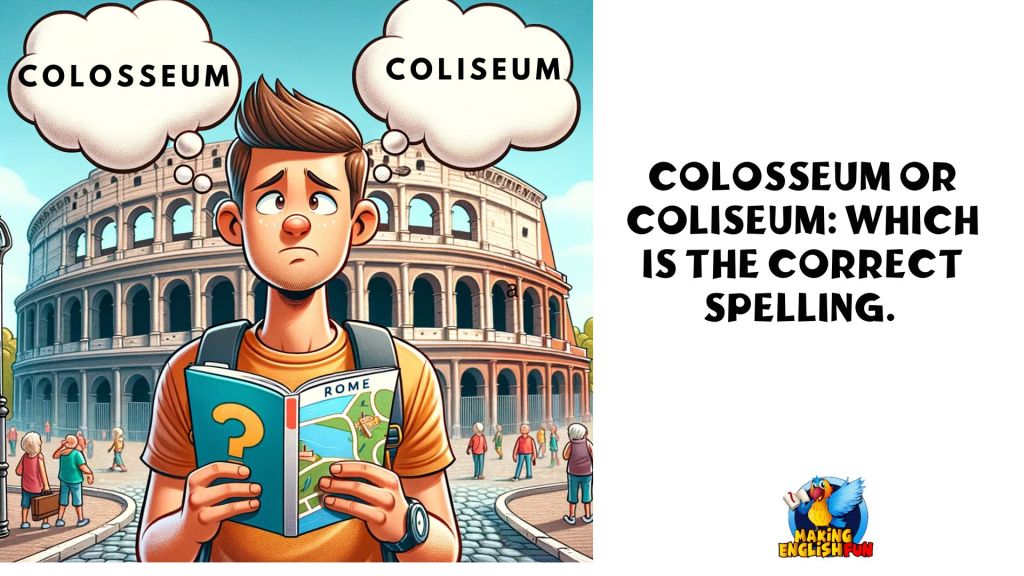
Colosseum or Coliseum: Which is the Correct Spelling.
Place names can always cause confusion in terms of spelling. “Colosseum” and “Coliseum” are two great examples of this and often surface, leading to a common spelling and usage query.
While seemingly similar, they refer to distinct entities. Clarifying the correct spelling and usage is crucial, particularly for accuracy in historical, architectural, and entertainment contexts.
Correct Spelling and Distinct Meanings
The Colosseum: The correct spelling for the ancient amphitheater in Rome is “Colosseum.”
This specific spelling is reserved for this iconic historical landmark, known for its rich history and architectural grandeur.
The Coliseum: The term “Coliseum,” often spelled with an ‘i’, is a generic name used for large auditoriums, sports stadiums, or entertainment venues worldwide.
It is not specific to any single structure.
The Colosseum: A Historical Marvel
Historical Background: The Colosseum, a massive stone amphitheater, was built in the heart of ancient Rome. It dates back to the first century AD and is renowned for hosting gladiatorial contests and public spectacles.
Architectural Significance: Celebrated as a marvel of ancient engineering, the Colosseum could hold thousands of spectators. Its design features innovative use of arches and a complex system of vaults.
Cultural and Touristic Importance: As a UNESCO World Heritage site, the Colosseum symbolizes the architectural prowess and cultural depth of the Roman Empire. It remains one of the most visited tourist attractions in the world.
The Coliseum: A Term for Modern Venues
General Usage: “Coliseum” is a broader term encompassing various modern structures used for significant public events, including sports, concerts, and conventions.
Examples and Variations: Numerous contemporary venues carry the name “Coliseum,” such as the Los Angeles Memorial Coliseum. These structures vary in design, capacity, and purpose, catering to diverse events.
Architectural Diversity: Unlike the ancient Colosseum, modern coliseums can range from grand sports stadiums to multipurpose indoor arenas, reflecting contemporary architectural styles and technological advancements.
Remembering the Correct Usage
- The Colosseum: Specifically refers to the ancient amphitheater in Rome. The ‘osseum’ in “Colosseum” can be remembered as ‘original site seen in Rome.’
- The Coliseum: A general term for large entertainment and sports venues. Think of the ‘iseum’ in “Coliseum” as ‘international entertainment stadiums.’
Extended Conclusion
Distinguishing between “Colosseum” and “Coliseum” is key to accurate communication in historical, architectural, and entertainment discussions.
The Colosseum stands as a testament to ancient Rome’s legacy, while coliseums around the world continue to be centers of vibrant public life and entertainment.
Extended FAQs or Reader Questions
- Is the Colosseum in Rome the only structure that should be called by that name?
- Yes, the term “Colosseum” is specifically used for the ancient amphitheater in Rome, distinguishing it from other structures.
- How do modern coliseums differ from the Colosseum in Rome?
- Modern coliseums vary in design and function, often equipped with contemporary amenities, and host a wide range of events unlike the ancient Colosseum.
- What historical events took place in the Colosseum?
- The Colosseum hosted events like gladiatorial contests, mock sea battles, animal hunts, and public spectacles.
- Can the term ‘Coliseum’ refer to any large public venue?
- Yes, “Coliseum” is a generic term for large public venues, especially those used for sports and entertainment.
- What makes the Colosseum an architectural wonder?
- The Colosseum’s advanced design for its time, including its elliptical structure, tiered seating, and elaborate underground complex, makes it an architectural wonder.
Further Resources
- https://www.quora.com/Why-is-the-Colosseum-not-spelled-Coliseum#.
- https://grammarist.com/spelling/colosseum-coliseum/
- https://www.reddit.com/r/OaklandAthletics/comments/40i0a3/does_anyone_know_whyhow_the_coliseum_is_spelled/
Making English Fun!

I have been a teacher of English for over 15 years, in that time i made hundreds and thousands of resources and learnt so much i think its worth sharing. Hopefully to help teachers and parents around the world.