Friend or Freind: Which is the Correct Spelling?
A common challenge in English spelling is determining the correct order of letters in words, particularly those with vowel combinations.
The words “Friend” and “Freind” often cause confusion due to their similar pronunciation and the common mix-up of ‘i’ and ‘e’.
The term “friend” is universally used in various contexts, from social interactions to digital communications, making its correct spelling crucial for clear and effective communication.
Whether you’re writing a letter, an email, or a social media post, understanding the correct spelling of “friend” is essential for maintaining the integrity of your communication.
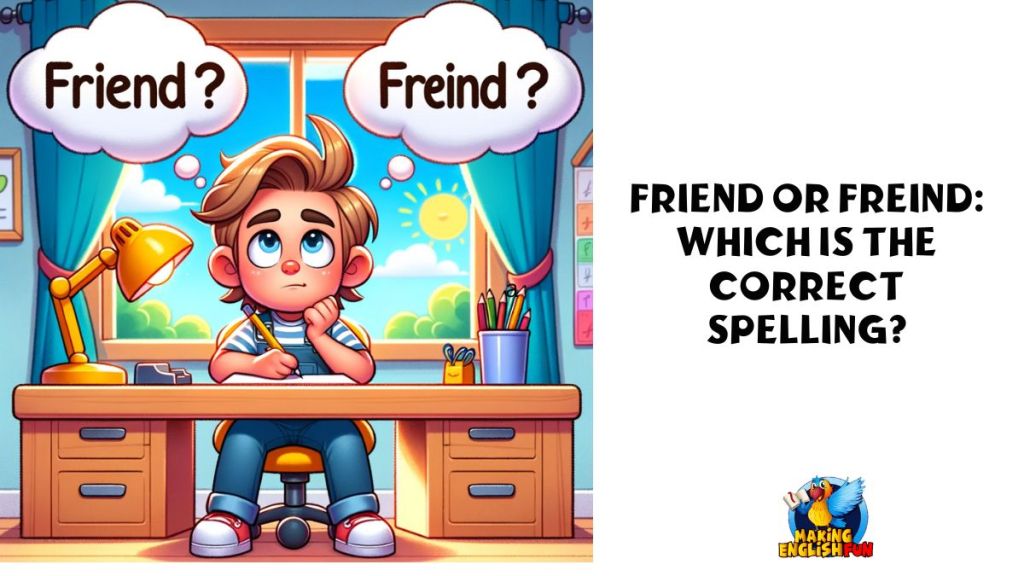
This article aims to resolve the confusion by clarifying the correct spelling of “friend” and offering insights to help you remember and use it accurately.
Correct Spelling and Definition
The correct spelling is “Friend,” with ‘i’ before ‘e’.
A friend is someone with whom one has a bond of mutual affection.
For example, “She met her best friend in high school,” indicates a close and personal relationship.
Common Spelling Error: Freind
The incorrect spelling “Freind,” with ‘e’ before ‘i’, is a frequent mistake. This error often occurs due to a misapplication of the commonly known rule ‘i before e, except after c’.
However, “Friend” is an exception to this rule, making it a unique case in English spelling.
Comparison with Other Common Spelling Confusions
Similar to “Friend,” other words often get misspelled due to the ‘i’ and ‘e’ placement. Here’s a comparison table showcasing some common spelling challenges:
| Correct Spelling | Common Incorrect Spelling |
|---|---|
| Friend | Freind |
| Believe | Belive |
| Receive | Recieve |
| Chief | Cheif |
| Field | Feild |
This table highlights the importance of understanding and memorizing the correct spellings of words that are frequently used but often misspelled.
Etymology and Historical Development
“Friend” comes from the Old English “frēond,” which meant ‘lover, friend,’ and was the present participle of “frēon,” meaning ‘to love.’
The spelling of “Friend” with ‘i’ before ‘e’ has remained consistent throughout its history in the English language, tracing back to its Germanic roots.
Usage in Different Contexts
“Friend” is used in a variety of contexts, ranging from everyday personal interactions to the realm of social media, where the term ‘friend’ has taken on new meanings.
For example, on social media platforms like Facebook, ‘friending’ someone means adding them to your network of contacts.
Tips for Remembering the Correct Spelling
A simple mnemonic to remember the correct spelling is:
“A friend is a friend until the end,” emphasizing that the word ‘friend’ ends with ‘iend.’
Also, regular use in writing and digital communication can help solidify the correct spelling in your memory.
Conclusion
Making sure the spelling of “Friend” is correct is obviously important to effective communication in both personal and professional spheres.
Accurate spelling not only ensures clarity but also reflects a good command of the English language. Understanding its origins and regular usage can greatly aid in memorizing its spelling.
FAQs and Reader Questions
- Why is the ‘i’ before ‘e’ rule not consistent in English?
- English is a language with many exceptions due to its diverse linguistic influences and historical developments. This leads to irregularities in spelling rules.
- How can I improve my spelling of words with ‘i’ and ‘e’ combinations?
- Regular reading and writing, paying close attention to spelling patterns, and using mnemonic devices can improve your ability to spell these words correctly.
- Are there any digital tools that help in learning the correct spellings of confusing words?
- Yes, there are various spelling and grammar checkers, educational apps, and online resources that offer exercises and quizzes for improving spelling.
- Is the misspelling of ‘Friend’ as ‘Freind’ common in English?
- Yes, it’s a common mistake, as many people rely on phonetic spelling or misapply the ‘i before e’ rule.
- How important is correct spelling in informal digital communication like texting?
- While informal communication can be more forgiving, consistent correct spelling enhances readability and understanding, even in casual conversations.
Further Resources
- https://prowritingaid.com/freind-or-friend#:~
- https://www.youtube.com/watch?v=FNoezM6hOKM
- https://oneminuteenglish.org/en/freind-or-friend/
Making English Fun!

I have been a teacher of English for over 15 years, in that time i made hundreds and thousands of resources and learnt so much i think its worth sharing. Hopefully to help teachers and parents around the world.