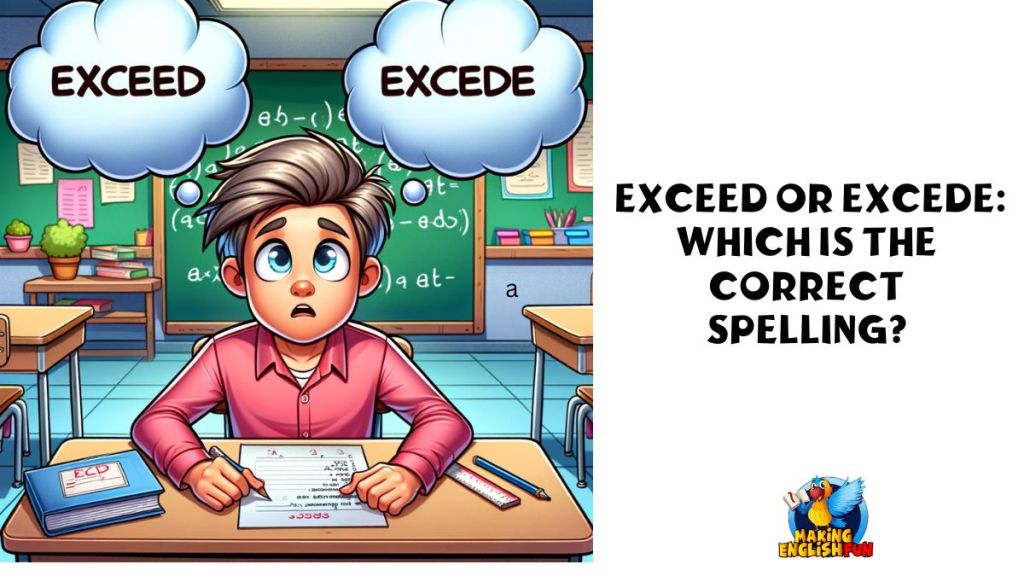
Exceed or Excede: Which is the Correct Spelling?
In English, choosing the correct spelling for certain words can sometimes be challenging, especially when two variations of a word seem possible.
This is the case with “Exceed” and “Excede.” This confusion often arises from uncertainties about the placement of ‘c’ and ‘e’ in the word.
The term “exceed” is widely used across various contexts, from academic writing to business communication, and its correct spelling is essential for conveying messages with clarity and precision.
This article aims to resolve the confusion by clarifying the correct spelling of “exceed” and providing insights to help you remember and use it accurately in your communication, whether it involves describing limits, expectations, or measurements.
Correct Spelling and Definition
The correct spelling is “Exceed,” with double ‘e’s following the ‘c’.
“Exceed” means to go beyond what is allowed or stipulated by a set limit, to be greater than, or to surpass.
For example, “The athlete aimed to exceed the world record,” indicates the goal of surpassing an established benchmark.
Common Spelling Error: Excede
The incorrect spelling “Excede,” with a single ‘e’ after the ‘c’, is a common mistake.
This error might stem from an incorrect assumption about the word’s composition based on its pronunciation.
However, the accurate spelling is “Exceed,” which aligns with its etymological roots.
Comparison with Other Common Spelling Confusions
Like “Exceed,” other words often get misspelled due to similar reasons.
Here’s a comparison table showcasing some common spelling challenges:
| Correct Spelling | Common Incorrect Spelling |
|---|---|
| Exceed | Excede |
| Independent | Independant |
| Privilege | Privelege |
| Occurrence | Occurence |
| Necessary | Neccessary |
This table highlights the importance of understanding and remembering the correct spellings of words that are frequently used but often misspelled.
Etymology and Historical Development
The word “exceed” is derived from the Latin “excedere,” which means “to go out, to go beyond, to surpass.”
This is composed of “ex-” (out) and “cedere” (to go).
The consistent use of double ‘e’s in “exceed” throughout its evolution into Middle and then Modern English reflects its Latin roots.
Understanding this etymological background can help clarify why “Exceed,” with double ‘e’s after the ‘c’, is the correct and historically consistent spelling.
Usage in Different Contexts
“Exceed” is a versatile word used across various fields and contexts. In business, it might refer to exceeding targets or expectations, as in “The sales team managed to exceed their quarterly goals.”
In legal contexts, “exceed” is used to describe surpassing defined limits, like “exceeding the speed limit.”
Accurate spelling in these contexts is crucial for maintaining the professionalism and precision of the communication.
Tips for Remembering the Correct Spelling
Remembering the correct spelling of “exceed” can be easier when linking it to its meaning of going beyond or surpassing.
Associating the double ‘e’ with the idea of ‘extra’ or ‘more than’ can serve as a mnemonic aid.
Additionally, frequent use and encounter with the word in reading material can help solidify the correct spelling in your memory.
FAQs and Reader Questions
Q1: Are there any other commonly confused words related to measurements or limits?
Yes, words like “threshold” (often misspelled as “threshhold”) and “gauge” (sometimes misspelled as “guage”) are also commonly confused in the context of measurements and limits.
Q2: How important is correct spelling in technical or scientific writing?
In technical and scientific writing, correct spelling is extremely important as it contributes to the accuracy and credibility of the information being presented.
Q3: Can incorrect spelling affect search engine optimization (SEO) for online content?
Yes, incorrect spelling can impact SEO as search engines favor content that is accurately spelled and well-written, which is seen as more reliable and authoritative.
Q4: Are spelling errors like ‘excede’ becoming more common with digital communication?
While digital communication tools often include spell-check features, reliance on these tools without understanding the rules can lead to frequent spelling mistakes.
Q5: What are some effective strategies for improving spelling in English?
Regular reading, writing practice, using language apps, and engaging in spelling quizzes or games are effective strategies for improving spelling in English.
Further Resources
- https://inkforall.com/copy-editing/spell-check/how-do-you-spell-excede/#:~:text=In%20English%2C%20the%20only%20correct,’
- https://spellhow.com/spelling/excede-or-exceed/
Making English Fun!

I have been a teacher of English for over 15 years, in that time i made hundreds and thousands of resources and learnt so much i think its worth sharing. Hopefully to help teachers and parents around the world.