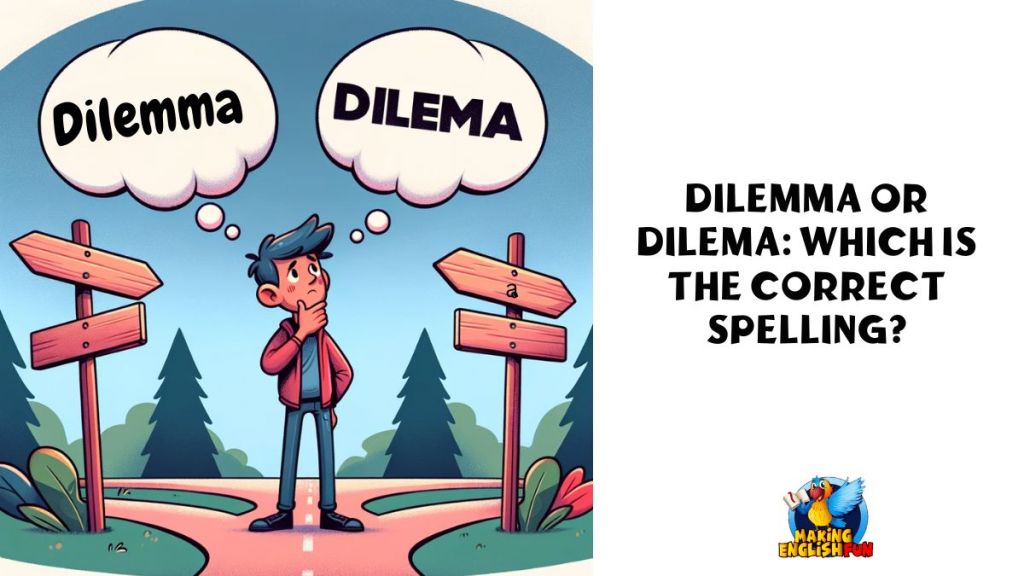
Dilemma or Dilema: Which is the Correct Spelling?
One of the common challenges in English spelling involves distinguishing between “Dilemma” and “Dilema.” We will refrain from making the “its quite the dilemma” joke after this!
This confusion often results from variations in pronunciation and a lack of awareness of the correct spelling.
The word “dilemma” is widely used in various contexts to describe a situation in which a difficult choice must be made between two or more alternatives.

This article aims to clarify the correct spelling of “dilemma” and provide guidance to help you use it correctly in different scenarios
Correct Spelling and Definition
The correct spelling is “Dilemma,” with double ‘m’s.
A dilemma is a situation in which a difficult choice has to be made between two or more alternatives, typically equally undesirable ones.
For instance, “He faced the dilemma of choosing between a career he loves and a well-paying job.”
Common Spelling Error: Dilema
The incorrect spelling “Dilema,” with a single ‘m’, is a common error.
This mistake might stem from an incorrect assumption about its spelling based on its pronunciation.
However, the correct spelling, “Dilemma,” always includes double ‘m’s, reflecting its etymological roots.
Comparison with Other Common Spelling Confusions
Here’s a comparison table showcasing similar spelling challenges:
| Correct Spelling | Common Incorrect Spelling |
|---|---|
| Dilemma | Dilema |
| Accommodate | Accomodate |
| Necessary | Neccessary |
| Occurrence | Occurence |
| Definitely | Definately |
This table not only reinforces the correct spelling of “Dilemma” but also emphasizes the importance of learning the correct spellings of other commonly miswritten words.
Etymology and Historical Development
The term “dilemma” has its roots in the Greek word “dilēmma,” which translates to “double proposition.”
It is a compound word, derived from “di-” meaning “two” and “lēmma,” meaning “premise or proposition.”
This etymological background explains the double ‘m’ in the spelling, as it aligns with the word’s origin and its meaning of a choice between two alternatives.
Usage in Different Contexts
“Dilemma” is used in a range of scenarios, from everyday decision-making to complex philosophical discussions.
In literature, characters might face moral dilemmas, while in business, leaders often encounter strategic dilemmas.
Understanding the correct usage of “dilemma” can aid in clearly conveying the nature of a difficult decision or situation in various contexts.
Tips for Remembering the Correct Spelling
One effective way to remember the spelling of “dilemma” is to think of the phrase
“Double M for a Double Problem,”
linking the double ‘m’ in “dilemma” to the idea of two problems or choices.
Regular usage and encounter with the word in reading and writing can also reinforce the correct spelling.
Conclusion
Correctly using “dilemma” in speech and writing reflects not only a grasp of its spelling but also an understanding of its meaning and applications.
Whether in academic writing, professional communication, or personal discussions, using “dilemma” accurately can enhance the clarity and depth of your expression.
Extended FAQs or Reader Questions
Q1: Why is it important to spell words like “dilemma” correctly in academic writing?
Correct spelling in academic writing is crucial as it demonstrates attention to detail and adherence to academic standards, lending credibility and clarity to your work.
Q2: Are there any specific techniques to improve spelling for complex words?
Techniques like breaking the word into syllables, using mnemonic devices, practicing with spelling quizzes, and regular reading can significantly improve spelling skills.
Q3: Can the incorrect spelling of a word like “dilemma” change its meaning?
While the meaning may not change, incorrect spelling can detract from the writer’s credibility and sometimes confuse the reader, especially if the misspelling leads to another existing word.
Q4: How often do spelling conventions change in English, affecting words like “dilemma”?
Spelling conventions in English evolve but generally change slowly over time. Standardized spellings, as in the case of “dilemma,” tend to remain consistent.
Q5: Is relying on spell-check a good strategy for learning correct spellings?
While spell-check tools are helpful, they should not replace active learning. Understanding the rules and patterns of spelling is essential for effective communication and self-reliance in writing.
Further Resources
- https://word.tips/spelling/dilemma-vs-dilema/
- https://strategically.co/blog/grammar-tips/dilemma-vs-dilemna/#:~:t
- https://www.quickanddirtytips.com/articles/dilemma-or-dilemna/
Making English Fun!

I have been a teacher of English for over 15 years, in that time i made hundreds and thousands of resources and learnt so much i think its worth sharing. Hopefully to help teachers and parents around the world.