Capital and Capitol: Which Spelling is Correct?
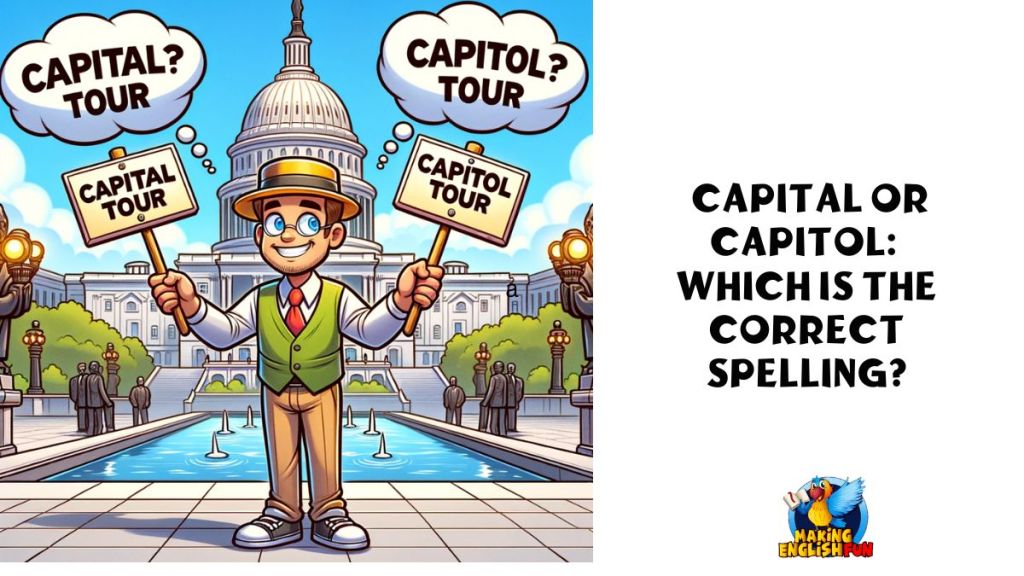
In English, certain words not only challenge us with their spelling but also with their meanings and usage. “Capital” and “Capitol” are prime examples of such words.
Often confused due to their similar pronunciation and close spelling, these terms have distinct meanings and uses.
This article aims to clarify the differences between “Capital” and “Capitol,” providing a comprehensive understanding that shows how these two words are used and spelt in different circumstances.
Understanding “Capital”
Correct Spelling and Definition: “Capital” refers to a city that serves as the seat of government and administrative center of a country or region.
It can also denote wealth in the form of money or other assets owned by a person or organization, as well as an uppercase letter.
- For example, in a geographical context: “Paris is the capital of France.”
- In an economic context: “The company needs more capital to expand its operations.”
Common Usage: “Capital” is used in multiple contexts, including:
- Geography: referring to the principal city in a region or country.
- Economics: describing financial assets or resources.
- Typography: indicating an uppercase letter.
Understanding “Capitol”
Correct Spelling and Definition: “Capitol” specifically refers to a building or complex of buildings where the legislature of a government meets.
In the United States, the term is often associated with the United States Capitol in Washington, D.C.
For example: “The senator will speak at the Capitol today.”
Common Usage: “Capitol” is primarily used in a political context to describe a building where a legislative body convenes.
Etymology and Historical Development
Capital: The word “Capital” comes from the Latin “capitalis,” which is derived from “caput,” meaning “head.”
Originally used to denote the head city or the most important city, its usage expanded over time to include financial and typographical meanings.
Capitol: “Capitol” has its roots in the Latin “Capitolium,” the name of the temple of Jupiter Optimus Maximus on the Capitoline Hill, one of the seven hills of Rome.
The term was later adopted in English to describe the site of the U.S. Congress.
Comparison with Other Common Spelling Confusions
Similar to “Capital” and “Capitol,” there are other word pairs that often get confused due to their close spelling and pronunciation.
Here’s a comparison table showcasing some of these:
| Correct Word | Common Incorrect Usage |
|---|---|
| Capital | Capitol |
| Stationary | Stationery |
| Principal | Principle |
| Compliment | Complement |
| Site | Sight, Cite |
This table emphasizes the importance of understanding the distinct meanings and correct spellings of commonly confused words.
Tips for Remembering the Correct Spelling and Usage
- For “Capital”: Think of the ‘a’ in “Capital” as standing for ‘administrative center.’
- For “Capitol”: Remember the ‘o’ in “Capitol” as representing the ‘only’ place where legislators meet.
Conclusion
Understanding the differences between “Capital” and “Capitol” is not just a matter of spelling accuracy; it reflects a depth of understanding of language and its application in different contexts and within English there are plenty of these!
Extended FAQs and Reader Questions
- Why is it important to differentiate between “Capital” and “Capitol”?
- Differentiating these terms is crucial for clear communication, particularly in political, geographical, and educational contexts, where precision in language is key.
- Can the misuse of ‘Capital’ and ‘Capitol’ lead to misunderstandings?
- Yes, using these words interchangeably can lead to confusion, especially in contexts where the distinction is important, such as in legal or governmental documents.
- How can I improve my understanding of similar-sounding English words?
- Regular reading, writing, and engaging in educational activities like vocabulary quizzes can enhance your understanding of such words.
- Are there any online tools to help learn the correct usage of words like ‘Capital’ and ‘Capitol’?
- Yes, there are numerous online dictionaries, language apps, and educational websites that provide definitions and examples to help learn their correct usage.
- Do native English speakers commonly confuse ‘Capital’ and ‘Capitol’?
- Yes, even native speakers can confuse these terms due to their similar pronunciation and close spelling
Further Resources
- https://www.scribbr.com/commonly-confused-words/capital-vs-capitol/#:~
- https://www.grammarly.com/blog/capital-vs-capitol/
- https://www.writersdigest.com/write-better-fiction/capital-vs-capitol-grammar-rules
Making English Fun!

I have been a teacher of English for over 15 years, in that time i made hundreds and thousands of resources and learnt so much i think its worth sharing. Hopefully to help teachers and parents around the world.