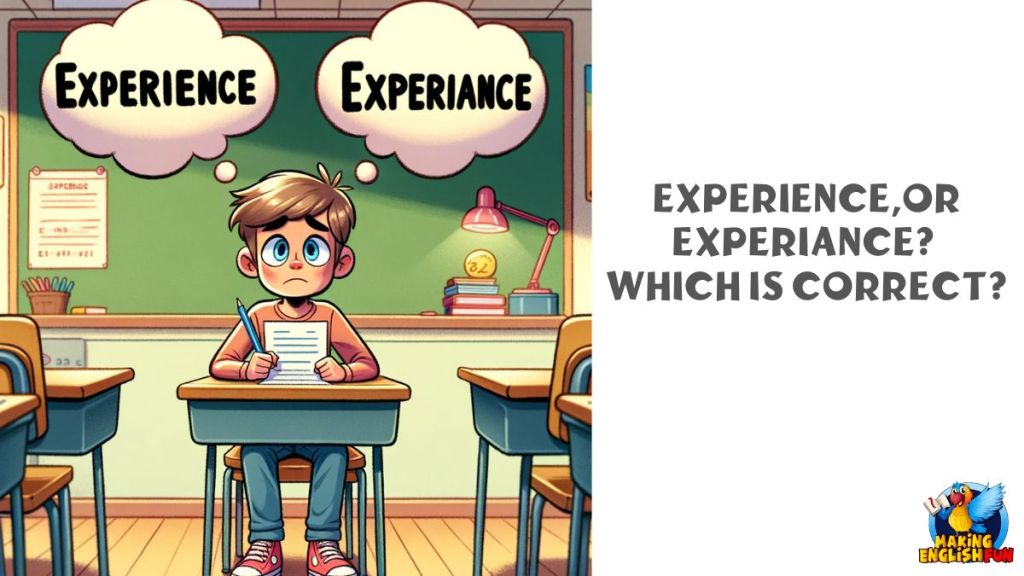
Experience or Experiance? Which Is Correct?
A common spelling question in English is whether to use “Experience” or “Experiance.”
This article aims to resolve this confusion by clarifying the correct spelling and usage of this often-used word, which refers to the knowledge or skill acquired by observing, encountering, or undergoing something.
Correct Spelling and Definition
The correct spelling is “Experience,” with an ‘e’ before the ‘n’.
“Experience” can refer to the practical contact with and observation of facts or events, as well as the knowledge or skill acquired over time.
For instance,
“She has a lot of experience in customer service,” implies that she has gained expertise in this area through practical involvement or exposure.
Common Spelling Error: Experiance
The incorrect spelling “Experiance” with an ‘a’ before the ‘n’ is a frequent mistake.
This error may arise from mispronunciation or misunderstanding of the word’s structure.
However, “Experience,” with ‘e-n-c-e’ at the end, is the only correct form.
Etymology and Historical Development
The word “Experience” comes from the Old French “experience,” derived from the Latin “experientia,” meaning “trial, proof, experiment, and knowledge gained by repeated trials.”
The Latin root is formed from “ex-” (out of, from) and “peritus” (experienced, tested).
This etymological background emphasizes the concept of learning or understanding gained from involvement in or exposure to events, which is central to the meaning of “Experience” in English.
Usage in Different Contexts
“Experience” is a versatile word used in various contexts. It can describe firsthand involvement in an event, as in “His experience in managing large teams is extensive.”
It can also refer to a particular incident or feeling, like “The concert was an amazing experience.”
Understanding how “Experience” is used in different sentences can help in grasping its broad applications.
Comparison with Other Common Spelling Confusions
The confusion over “Experience” is similar to other common spelling errors in English.
For instance, “independent” is often misspelled as “independant,” and “necessary” as “neccessary.”
Here’s a quick comparison:
| Correct Spelling | Common Incorrect Spelling |
|---|---|
| Experience | Experiance |
| Independent | Independant |
| Necessary | Neccessary |
This table highlights how easy it is to misspell words due to misunderstandings of their correct forms.
Tips for Remembering the Correct Spelling
A useful mnemonic for remembering the correct spelling of “Experience” is to think of the phrase “Every New Challenge Explores Real Intelligence, Experience, and Nuance.”
This phrase uses the first letter of each word to spell out “EXPERIENCE,” reinforcing the correct spelling.
Additionally, regular use of the word in writing and conversation can help cement its correct spelling in your memory.
Conclusion
In summary, “Experience,” spelled with an ‘e’ before the ‘n’, is the correct spelling.
This term, which encompasses a wide range of meanings from practical exposure to emotional encounters, is a key element in both personal and professional growth.
Accurate spelling of such words is essential for effective communication and clear expression of ideas.
FAQs or Reader Questions
Q1: Why do certain words like “experience” have multiple spelling confusions?
Spelling confusions often arise from phonetic misinterpretations and variations in pronunciation. Words like “experience” can be easily misspelled if their phonetic structure is misunderstood.
Q2: How can I improve my spelling of complex words?
Improving spelling for complex words involves regular practice, reading widely to see words used in context, and employing memory aids like mnemonics. Understanding the word’s origin and meaning can also be beneficial.
Q3: Is correct spelling still important in the era of autocorrect and spell-check?
Yes, correct spelling remains important even with autocorrect and spell-check tools. Relying solely on these tools can lead to overdependence and hinder the development of spelling skills.
Q4: Can learning about word origins help in other areas of language study?
Learning about word origins, or etymology, can enrich vocabulary, enhance understanding of language structures, and improve spelling and comprehension skills.
Q5: Are spelling errors a major concern in informal communication?
In informal communication, minor spelling errors are usually overlooked. However, consistently correct spelling can enhance clarity and readability, even in informal settings.
Further Resources
- https://thecontentauthority.com/blog/experience-vs-experiance
- https://oneminuteenglish.org/en/working-experience-work-experience/
Making English Fun!

I have been a teacher of English for over 15 years, in that time i made hundreds and thousands of resources and learnt so much i think its worth sharing. Hopefully to help teachers and parents around the world.