Noun Phrase Examples
A substantial part of most English curricula, and a sign that there is always a new way to describe or re- name something we have been doing for years, noun phrases play a crucial role in the beginning phases of learnings English and we have some noun phase examples to help teachers teach and students learn all about noun phrases.
While The word noun is fairly common the term noun phrases can cause a little confusion. However, they’re not just grammar terms – they’re key to making your writing clear and engaging.

In this guide, we’ll get to the heart of noun phrases and show you plenty of noun phrase examples and how they can improve your writing.
We also have a free download with noun phrase examples from simple to enhanced, with post and pre modifiers included you can find linked below in Section 2. Along with a series of 4 noun phrase worksheets to practice with.
What are Noun Phrases
Noun phrases are like the secret sauce in a delicious meal – they add flavor and substance to your sentences. But what exactly are they?
Simply put, a noun phrase is a group of words that collectively act as a noun.
Think of it as a team where each member contributes to the goal.
This team usually includes a noun (the star player) and sometimes other words (the supporting players), like adjectives or determiners.
Let’s make this fun with an example.
Consider the phrase “a bouquet of vibrant flowers.” Here, “a bouquet” is our main noun, and “of vibrant flowers” adds an extra punch of imagery and description.
It’s like going from a simple sketch to a vivid painting!

Varieties of Noun Phrases
Noun phrases come in all shapes and sizes, and they’re not just about adding adjectives to nouns.
They can be short and sweet like “the cat,” or they can be a bit more elaborate, like “the cat with the mischievous grin.”
The beauty of noun phrases is their versatility.
They can describe characters in a story, set the scene in a narrative, or add detail in a report.
But here’s where it gets really interesting – noun phrases can also include gerunds (verbs acting as nouns) or even entire clauses!
For instance, “Running swiftly” or “The idea that the world is round” are both noun phrases. They can be the subject of your sentence, like “Running swiftly is exhilarating,” or the object, like “I believe the idea that the world is round.”
Introduction to Simple Noun Phrases
In the realm of grammar, simple noun phrases are the starting blocks of sentence construction.
They typically consist of a single noun or pronoun that serves as the subject or object within a sentence. These core components can stand alone or act as the foundation for more complex phrases.
Examples:
- The word “dog” in the sentence “The dog barked loudly,” is a simple noun phrase acting as the subject.
- “They” is used as a simple noun phrase in “I saw them at the park,” where it functions as the object.
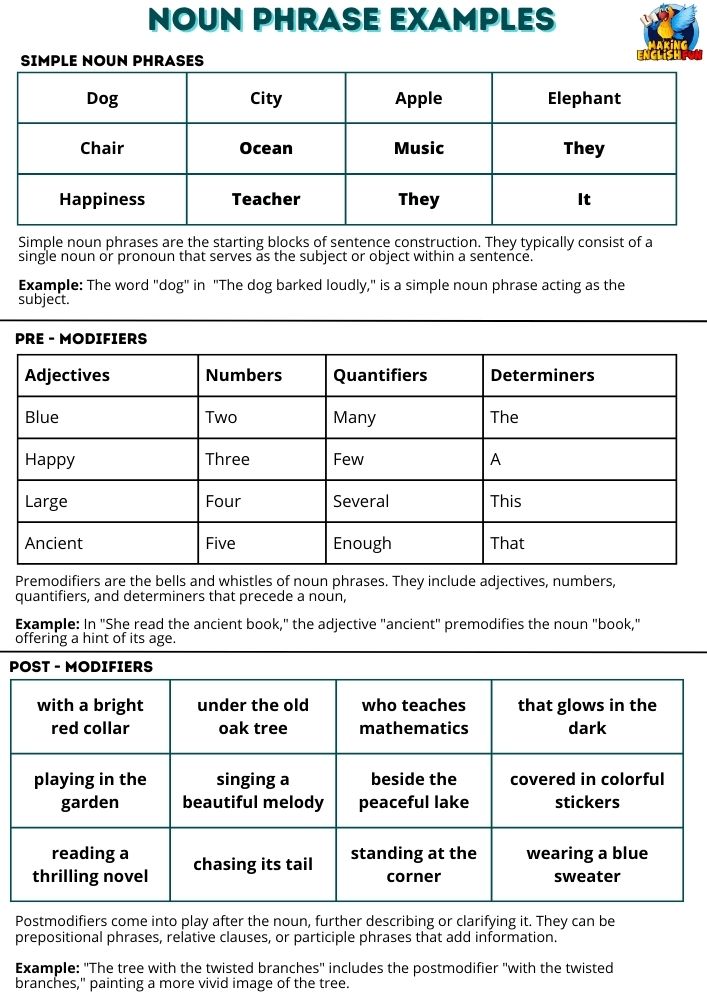
Simple Noun Phrase Examples
| Dog | City | Apple | Elephant |
| Chair | Ocean | Music | They |
| Happiness | Teacher | They | It |
These examples show how simple noun phrases can fulfill different roles in sentence structures, even in their most basic form.
Introduction to Premodifiers in Noun Phrases
Premodifiers are the bells and whistles of noun phrases. the expand the noun phrase.
They include adjectives, numbers, quantifiers, and determiners that precede a noun, adding specificity, quantity, or description.
These modifiers enrich the noun phrase, providing a clearer picture or limiting the scope of the noun.
Examples:
- In “She read the ancient book,” the adjective “ancient” premodifies the noun “book,” offering a hint of its age.
- “Three cats” uses the number “three” as a premodifier to indicate how many cats are being referred to.
| Adjectives | Numbers | Quantifiers | Determiners |
| Blue | Two | Many | The |
| Happy | Three | Few | A |
| Large | Four | Several | This |
| Ancient | Five | Enough | That |
Premodifiers like these help us to convey more detailed information in our sentences as well as expanding the noun phrase
Introduction to Postmodifiers in Noun Phrases
Postmodifiers come into play after the noun, further describing, expanding or clarifying it.
They can be prepositional phrases, relative clauses, or participle phrases that add information about location, time, reason, and much more.
Postmodifiers are essential when you want to give your reader a complete understanding of the noun in context.
Examples:
- “The tree with the twisted branches” includes the postmodifier “with the twisted branches,” painting a more vivid image of the tree.
- “The man who visited yesterday” uses a relative clause as a postmodifier to specify which man is being referred to.
| with a bright red collar | under the old oak tree | who teaches mathematics | that glows in the dark |
| playing in the garden | singing a beautiful melody | beside the peaceful lake | covered in colorful stickers |
| reading a thrilling novel | chasing its tail | standing at the corner | wearing a blue sweater |
These postmodifiers provide the necessary details that can turn a simple noun into the main focus of a sentence.
You can Download these noun phrase examples on the download button below.
How to Make Expanded Noun Phrases
Now, let’s spice things up a bit with expanded noun phrases.
Think of them as the deluxe version of your standard noun phrase.
An expanded noun phrase throws in a few extra ingredients – like adjectives, prepositions, and additional nouns – to make your sentence even more flavorful.
Imagine you’re painting a picture with words. Instead of just saying “the dog,” you can create a vivid image like “the fluffy, energetic dog lounging in the sunny backyard.”
See the difference? It’s about adding color and depth to your sentences, making them more descriptive and engaging.
This isn’t just useful for creative writing; it’s a powerful tool in any kind of communication, helping you convey your thoughts more precisely and vividly.
Ways to use Noun phrases
Let’s dive into some unique examples to see expanded noun phrases in action.
Consider the simple noun phrase “the cake.” Now, let’s expand it: “the rich, creamy chocolate cake decorated with fresh strawberries.”
Can you almost taste it? That’s the power of an expanded noun phrase!
But it’s not just about food. Take a scientific report, for example. Instead of writing “the experiment,” you could say “the groundbreaking experiment that changed our understanding of physics.”
These expanded noun phrases help you tell a fuller, richer story, no matter the context.
Noun Phrases in Context
Noun Phrases in Literature and Media
Noun phrases are everywhere, from the novels of Jane Austen to the headlines in your morning newspaper.
- In literature, they help authors paint vivid scenes and develop complex characters.
- In media, they’re used to grab your attention and convey information quickly and effectively.
Let’s look at a classic example from literature:
“The quick brown fox jumps over the lazy dog.” Here, “the quick brown fox” and “the lazy dog” are noun phrases that instantly create vivid characters in your mind.
In journalism, a headline like “The daring rescue operation at sea” uses a noun phrase to immediately tell you what’s important.
Noun Phrases Real-World Applications
Noun phrases are not just for writers and journalists; they’re essential in everyday communication too.
They help us give detailed instructions, make persuasive arguments, and even crack jokes.
For instance, in a business presentation, instead of saying “our strategy,” you might say “our innovative, customer-focused strategy.”
This gives your audience a clearer picture of what sets your strategy apart.
Teaching Noun Phrases Effectively
Innovative Teaching Methods and Resources
Teaching noun phrases can be a fun and interactive experience. It’s not just about drilling grammar rules; it’s about encouraging students to play with language and see its possibilities.
Here are some innovative ideas:
- Story Building Games: Start with a simple noun phrase and have each student add to it, creating a more detailed and imaginative phrase. This not only teaches the structure of noun phrases but also sparks creativity.
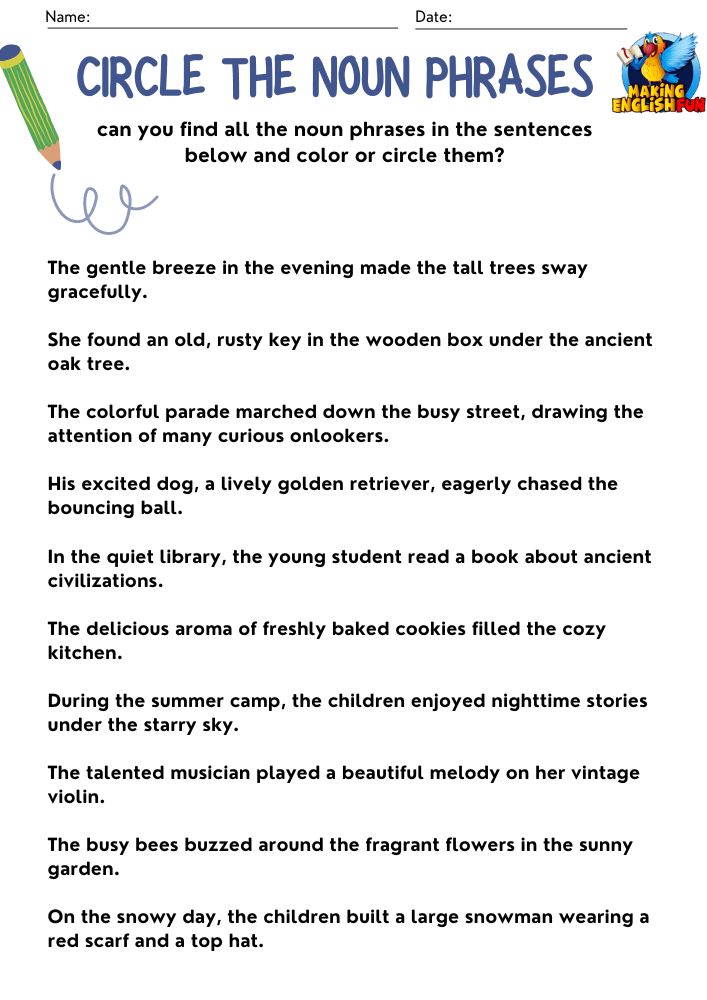
- Noun Phrase Hunt: Turn a reading session into a treasure hunt by asking students to identify noun phrases in a text. This helps them recognize noun phrases in context and understand their usage.
- Digital Tools: Use apps and online games that focus on building noun phrases. These tools can provide instant feedback and make learning more engaging.
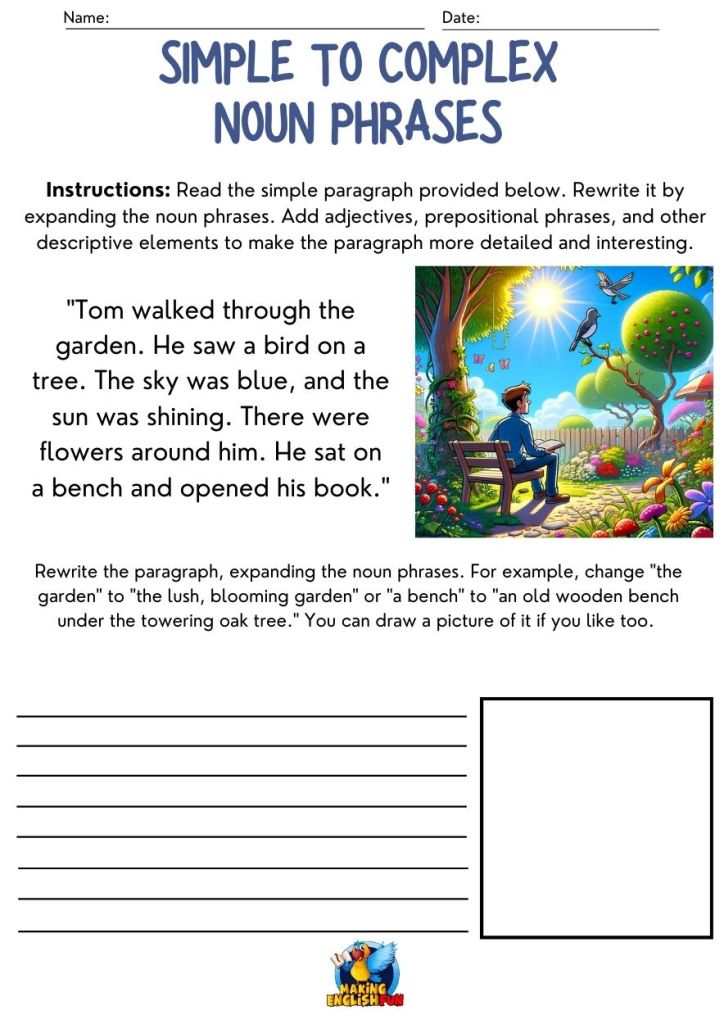
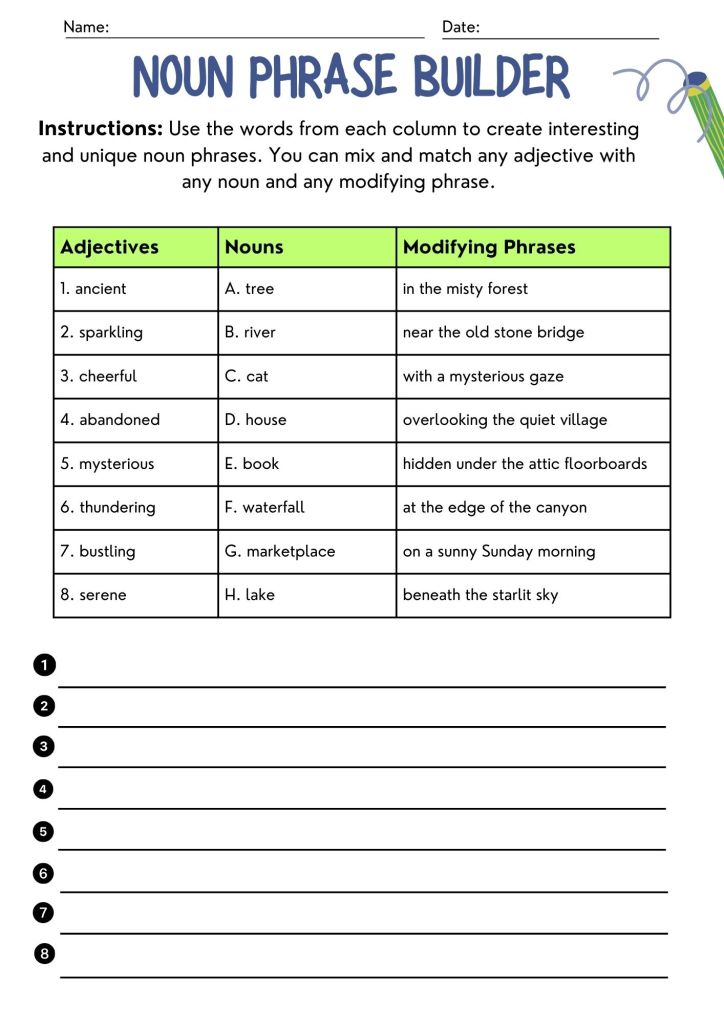
- As we mentioned above we also have a FREE selection of noun phrase worksheets you can access here on the site. the link is below.
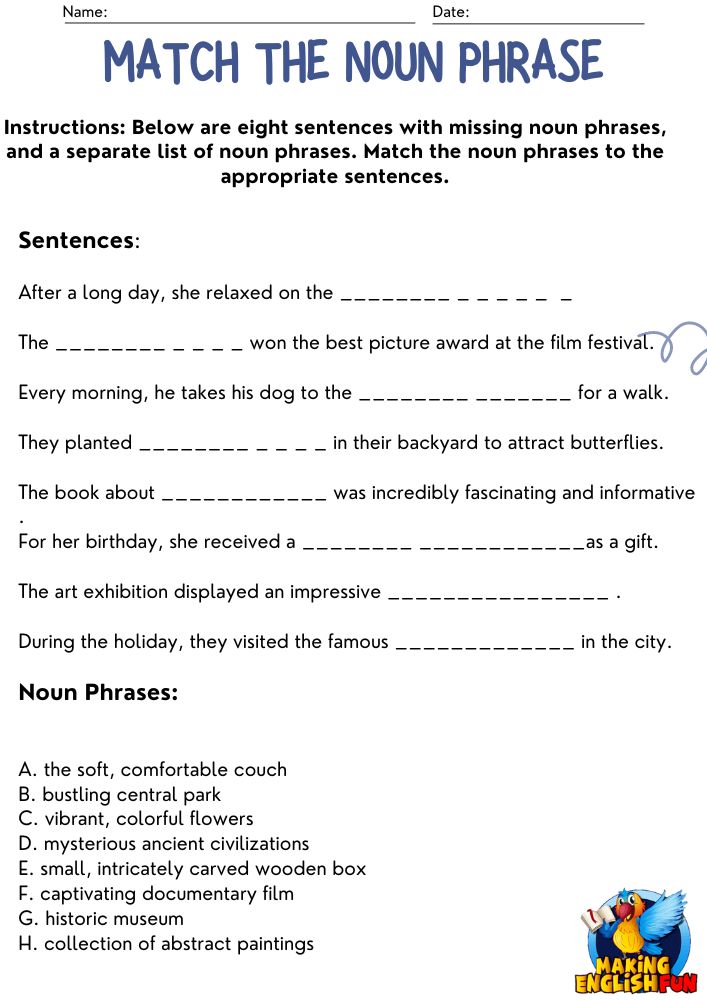
Remember, the key is to make learning noun phrases an adventure, not a chore!
Noun Phrases Across Age Groups
Different age groups grasp concepts in varying ways. For younger students, focus on simple noun phrases, using familiar and concrete examples.
As students grow older, introduce more complex noun phrases and encourage them to use them in their writing.
This gradual increase in complexity helps build confidence and understanding.
Troubleshooting Common Challenges
Let’s face it, learning noun phrases can sometimes be a bit tricky. But fear not! Here are some common challenges learners face and how to overcome them:
- Overcomplicating Phrases: Keep it simple. Start with basic structures before moving to more complex ones. Remember, clarity is key.
- Confusing Adjectives and Nouns: It’s easy to mix these up in expanded noun phrases. Practice identifying each part of speech through exercises and examples.
- Making Phrases Too Long: While expanded noun phrases are great, there’s such a thing as too much. Teach students to strike a balance – descriptive, yet concise.
- Contextual Usage: Understanding when and how to use noun phrases appropriately comes with practice. Encourage reading and writing in various styles and formats.
Solutions and Practice Exercises
To help, we’ll have a set of four noun phrase worksheets linked here on the site that provide a range of practice exercises and solutions to these common issues.
English Curriculum
In the English National Curriculum, particularly in England, noun phrases are introduced and developed as part of the primary school English curriculum. Key aspects include:
- Key Stage 1 (Years 1 and 2): Children begin to learn about nouns and expand their understanding by adding adjectives to make their writing more descriptive. The concept of a simple noun phrase (a noun and its modifiers) is introduced.
- Key Stage 2 (Years 3 to 6): The curriculum expands on the understanding of noun phrases. Pupils are expected to use more sophisticated noun phrases with modifiers (including adjectives, nouns as modifiers, and prepositional phrases) to create specificity and interest in their writing. For instance, in Year 4, they learn about expanded noun phrases for description and specification (e.g., “the blue butterfly” or “the man in the moon”).
American Curriculum
In the United States, the Common Core State Standards (CCSS) for English Language Arts provide a framework for teaching noun phrases, though the specifics can vary by state. Key aspects include:
- Elementary School: Students are introduced to nouns and adjectives in the early grades. They learn to form simple noun phrases by combining these parts of speech.
- Middle School: As students progress to higher grades (typically 6th to 8th grade), they learn more complex sentence structures. This includes the use of expanded noun phrases that incorporate adjectives, prepositional phrases, and appositives to add detail and clarity to their writing.
- High School: In high school, students are expected to have a refined understanding of noun phrases and use them effectively in their writing across different subjects. They analyze how noun phrases function in different contexts, including in literature and technical writing.
Both curricula emphasize the development of noun phrases as a tool for enhancing descriptive and precise writing.
- In the English curriculum, there is a specific focus on expanded noun phrases,
- while the American curriculum includes a broader approach to complex sentence structures in which noun phrases play a significant role.
Conclusion
Noun phrases may seem like just another grammatical concept, but they hold the power to transform your writing and communication skills. By understanding and mastering noun phrases, you can create more vivid, engaging, and precise expressions in your language.
We hope this guide has shed some light on noun phrases and given you plenty of noun phrase examples and inspired you to explore them further in your writing.
Remember, language is a playground, and noun phrases are one of the fun sides slides to explore!
Further Resources
- https://learnenglish.britishcouncil.org/grammar/english-grammar-reference/noun-phrases
- https://emile-education.com/noun-phrases-expanded/
- https://www.grammar-monster.com/glossary/noun_phrases.htm
- https://www.masterclass.com/articles/what-is-a-noun-phrase
Making English Fun!

I have been a teacher of English for over 15 years, in that time i made hundreds and thousands of resources and learnt so much i think its worth sharing. Hopefully to help teachers and parents around the world.