How to Teach Hard and Soft G Sounds.
Teaching the sounds of the English language is a key part of literacy education.
Among these sounds, the hard and soft ‘G’ sounds are particularly important due to their frequent use in the language.
Understanding the difference between these two sounds is essential for accurate pronunciation and spelling.
To teach hard and soft ‘G’ sounds, introduce the rules and examples (hard ‘G’ as in ‘goat’, soft ‘G’ as in ‘giraffe’). Use engaging activities like sound sorting games, ‘G’ sound bingo, and fill-in-the-blank stories. Regular practice, audio exercises, and creative writing prompts help learning these sounds.
This article will explore the hard and soft ‘G’ sounds, providing teachers and parents with strategies and activities to effectively teach the difference between the same letter and its different sounds.
Understanding Hard and Soft ‘G’ Sounds
The hard ‘G’ sound, as in the word ‘goat,’ is similar to the ‘G’ in ‘give’ or ‘garden.’
In contrast, the soft ‘G’ sound, found in words like ‘giraffe’ or ‘gem,’ is pronounced more like a ‘J’ sound.
The key to identifying whether a ‘G’ is hard or soft often depends on the letter that follows it in a word.
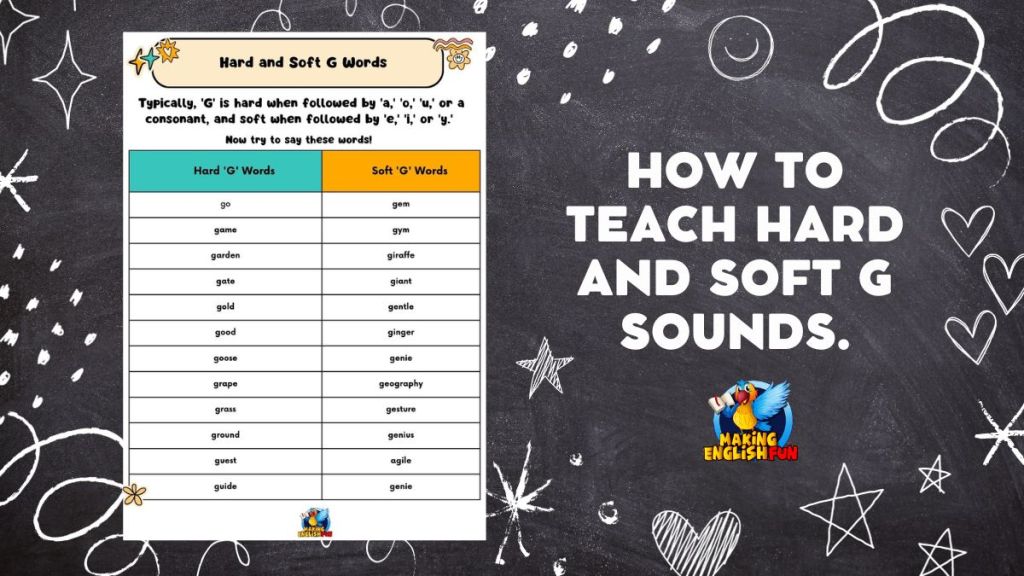
Typically, ‘G’ is hard when followed by ‘a,’ ‘o,’ ‘u,’ or a consonant, and soft when followed by ‘e,’ ‘i,’ or ‘y.’
However, there are exceptions to these rules, which can make learning these sounds a bit challenging.
Examples of hard ‘G’ words include
- ‘golf,’
- ‘grape,’
- and ‘grow,’
while soft ‘G’ words include
- ‘gentle,’
- ‘giant,’
- and ‘gypsy.’
and you can download a handout of examples from the link below and look at the table here on the page as well.
Table of Hard and Soft G words.
| Hard ‘G’ Words | Soft ‘G’ Words |
|---|---|
| go | gem |
| game | gym |
| garden | giraffe |
| gate | giant |
| gold | gentle |
| good | geography |
| goose | ginger |
| grape | genie |
| grass | gesture |
| grill | gel |
| ground | general |
| grow | generate |
| guard | genius |
| guest | germinate |
| guide | agile |

The Role of Hard and Soft ‘G’ Sounds in Language Learning
The correct pronunciation of hard and soft ‘G’ sounds is obviously important for reading fluency and accurate spelling.
Understanding these sounds also assists in vocabulary development, as students become more aware of the differences in word pronunciation and meaning.
Preparation for Teaching
Before teaching hard and soft ‘G’ sounds, teachers and parents should gather materials and plan their approach.
This includes creating or sourcing word lists (we have ours to download above) that clearly demonstrate both sounds, and preparing visual aids like flashcards or charts.
It’s also beneficial to have audio examples of words with hard and soft ‘G’ sounds for students to listen to, aiding in their recognition of these sounds.
Preparing engaging and interactive activities is key to keeping students interested and involved in the learning process and we have a selection of ideas below.
Activity-Based Learning for Hard and Soft ‘G’ Sounds
Teaching the hard and soft ‘G’ sounds can be made engaging and effective through various activities.
Here are some detailed ideas:
Sound Sorting Game:
Create flashcards with words containing hard and soft ‘G’ sounds. Have students sort these cards into two piles based on the sound of ‘G’.
This activity helps in reinforcing the auditory difference between the two sounds.
‘G’ Sound Bingo:
Prepare bingo cards with a mix of hard and soft ‘G’ words. Play recordings of these words and have students mark their bingo cards when they hear a word.
This is a fun way to develop listening skills and sound recognition.
Matching Game:
Use pairs of words where one word has a hard ‘G’ and the other has a soft ‘G’ (e.g., ‘gate’ and ‘giraffe’).
Students match pairs based on the ‘G’ sound. This reinforces the concept that the same letter can produce different sounds.
Fill-in-the-Blank Stories:
Create short stories with missing words that contain hard and soft ‘G’ sounds.
Students fill in the blanks with appropriate words, practicing their understanding of the sounds in context.
Pronunciation Practice:
Regular drills focusing on pronouncing words with hard and soft ‘G’ sounds correctly.
This could involve repeating words, phrases, or sentences.
Creative Writing Prompts:
Encourage students to write stories or sentences using a mix of hard and soft ‘G’ words.
This activity helps in applying their phonetic knowledge creatively.
Word Hunt:
Assign students to find and list words from their reading materials or surroundings that contain hard and soft ‘G’ sounds, promoting active engagement with their environment.
Audio Listening Exercises:
Play audio clips of words and ask students to identify whether the ‘G’ sound is hard or soft.
This enhances their listening and analytical skills.
we also have a teaching and resource guide on how to teach the Soft C and Hard C sounds here on the site if you need this.
Common Challenges and Solutions
Students may face several challenges when learning hard and soft ‘G’ sounds.
- Some might struggle with distinguishing the sounds, especially in words where the rules are not straightforward.
- Others may find it difficult to remember which sound corresponds to which letter combination.
To address these challenges, teachers can use repetition and varied activities to reinforce learning.
Additionally, providing mnemonic devices or visual cues can help students remember the rules more easily.
Regular practice and exposure to a variety of words will gradually improve their proficiency.
Assessment and Progress Tracking
Effectively assessing students’ understanding of hard and soft ‘G’ sounds is crucial. This can be done through:
- Oral Reading: Have students read passages aloud, paying attention to their pronunciation of words with hard and soft ‘G’ sounds. This helps in assessing their ability to apply their knowledge in real-time.
- Spelling Tests: Regular spelling tests with a focus on words that contain hard and soft ‘G’ sounds can be an effective way to gauge students’ understanding and recall.
- Phonics Worksheets: Worksheets that require students to identify, sort, or write words based on the ‘G’ sound they contain can provide tangible evidence of their comprehension.
- Class Participation: Observing students during activities and discussions can give insights into their grasp of the concepts and their ability to apply them in different contexts.
To track progress, maintain records of students’ performance in these assessments over time.
Adjust teaching methods based on the areas where students show the most difficulty.
Conclusion
While learning hard and soft G presents unique challenges, the use of varied teaching strategies and regular practice can lead to significant improvements in students’ reading and spelling skills.
Further Resources
- https://aroundthekampfire.com/2023/01/hard-and-soft-c-and-g-activities-lesson-plans-to-teach-them.html
- https://www.theliteracynest.com/2021/11/teaching-hard-and-soft-g-sounds.html
- https://missgiraffesclass.blogspot.com/2022/02/how-to-teach-hard-and-soft-g.html
- https://thriveedservices.com/hard-g-and-soft-g/
Making English Fun!

I have been a teacher of English for over 15 years, in that time i made hundreds and thousands of resources and learnt so much i think its worth sharing. Hopefully to help teachers and parents around the world.